What to order
Three ways to build the table.
There are no special holiday boxes — the fish is the same fish we sell every week, which is the point. Choose two packs that contrast, and add one luxury course if the night calls for it. Prices are for the fish; the Home Sushi Kit is $50.
| Plan | What's in it | Fish | With the Kit |
|---|---|---|---|
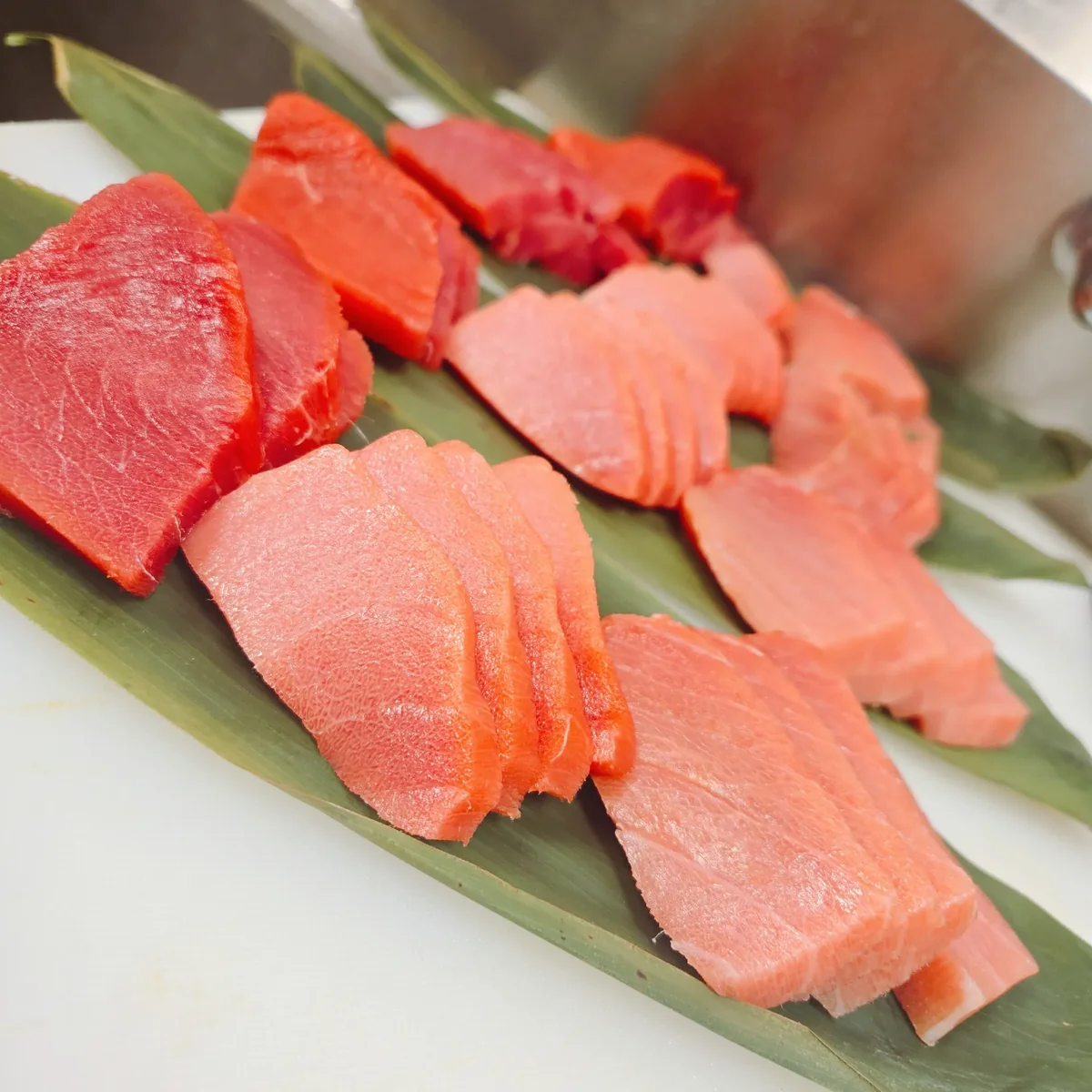
| Balanced | Chutoro + Sasshu Salmon — rich bluefin belly next to a clean, mild salmon | $130 | $180 |
| All bluefin | Otoro + Akami — the fattiest belly and the lean red loin, side by side | $129 | $179 |
| Luxury | Chutoro + Sasshu Salmon + a ~40 g tray of Hokkaido uni | $180 | $230 |
Each of these clears $150 in food once the Kit is included, so delivery is free (Sashimi DC covers the delivery fee; the $3 service charge and any tip still apply). Feeding more than two, or not sure which cuts to pair? Ask at the counter or text us from the shop — we are happy to help you size and plan the meal. For cut-by-cut detail, see sashimi-grade Bluefin Tuna and sashimi-grade salmon.
By occasion
Every occasion, one simple plan.
The plan above works for almost every celebration. What changes is the feel of the evening — here is how customers make each one their own.
Anniversary & date night
Serve it as courses: uni first, then sashimi, then hand rolls you make together at the table. Making the meal is part of the gift — slow down and let it take the evening.
Birthday
Build it around the guest of honor's favorite cut. Otoro is the classic splurge; hand rolls (temaki) let everyone join in without any sushi skills.
Valentine's Day
Around Valentine's we sometimes offer limited uni packages for couples, announced through the newsletter and Instagram. See uni for special occasions. Order early — the week of Valentine's sells out.
Holidays & New Year's Eve
A sashimi platter is an easy centerpiece for a holiday gathering: slice it before guests arrive and keep it chilled. Check Updates for holiday hours and last order days.
Family visiting
Hand-roll night is the easiest way to feed parents and kids together. See sashimi for families for what suits younger eaters.
Not hosting? Give it.
Fish is perishable, so a gift card works better than a gift of fish — the recipient picks the cuts and the night. See Sashimi DC gift cards.
Japanese New Year
Fish for the New Year — toshitori-zakana.
In Japan, the New Year meal traditionally began on New Year's Eve with the toshitori-zen, the year-end table set to welcome the year's god (toshigami). Its centerpiece was the toshitori-zakana (年取り魚), the "year-taking fish." Salmon and buri (yellowtail) were the two main ones — salted to keep, and carried long distances inland. Salmon dominates in eastern Japan and buri overwhelmingly in western Japan (Kibun Foods, 2022 survey).
Sea bream (tai) is the celebration fish above all — its name echoes medetai, "auspicious," and it became the standard offering at shrines. Shrimp stands for long life. Tuna, by contrast, only became a luxury food after the war — yet it now ranks among the top celebration fish in Japanese homes (Yamamoto, for Kibun Foods).
| Rank | New Year | Other celebrations |
|---|---|---|
| 1 | Yellowtail (buri) — 918 | Sea bream (tai) — 1,475 |
| 2 | Sea bream (tai) — 689 | Tuna (maguro) — 555 |
| 3 | Herring roe (kazunoko) — 459 | Salmon (sake) — 340 |
| 4 | Shrimp (ebi) — 416 | Shrimp (ebi) — 310 |
| 5 | Salmon (sake) — 396 | Squid (ika) — 287 |
| 6 | Tuna (maguro) — 251 | Yellowtail (buri) — 189 |
| 7 | Squid (ika) — 153 | Eel (unagi) — 122 |
Number of mentions by Japanese households asked which fish they eat at New Year and at other celebrations (Kibun Foods household survey, analysis by folklorist Shino Yamamoto). In Kibun's 2022 follow-up, salmon slipped further down the New Year list as it became Japan's everyday fish.
Bringing it to your table in DC. We do not carry buri, but the rest of the tradition is here: Sasshu Salmon for the eastern-Japan salmon table, Goto Islands Bluefin Tuna for the modern celebration favorite, Madai (sea bream) fillets when in stock, Ikura Shoyuzuke (soy-marinated salmon roe, $34.50 / ~5 oz), and Kagoshima unagi kabayaki ($40). For New Year's Eve, order by the last order day posted on our Updates page — the counter is busiest that week.
Timing
When to order for the big night.
-
1
Fish arrives every Wednesday
New shipments land from Japan mid-week. Thursday and Friday are the best days to order — the counter is fully stocked. Popular cuts can sell out by Saturday afternoon.
-
2
Pick up or get it delivered the same day
Pickup daily 11:30 am – 8:00 pm at 1608 14th St NW (lower level, inside Rice Market). Delivery daily 1:00 – 8:00 pm across DC, Northern Virginia and Maryland — order by 7:30 pm for same-day delivery.
-
3
Make the rice first, slice the fish last
Sushi rice is best eaten within the hour, at near body temperature. Keep the fish in the fridge until just before serving, then slice. The home sushi guide walks through rice, slicing and hand rolls.
Why at home
Better fish than the restaurant, at your own pace.
The fish on your table is Ikejime-processed, never-frozen Bluefin and Sasshu Salmon, imported directly from Japan and available the day it clears customs — at a fraction of an omakase bill. For the full comparison of cost, freshness and traceability, see the best sushi in Washington DC is at your table.
Sources
Kibun Foods — 正月と魚 ~ハレの日の家庭の食文化~ (survey data: fish eaten at New Year, celebrations and every day); research, analysis and commentary by folklorist Shino Yamamoto.
Kibun Foods — 縁起物としての魚 (Fish as auspicious foods); Shino Yamamoto.
Kibun Foods — 年とり膳のごちそう「年とり魚」 (Toshitori-zakana); online survey of 5,875 households, October–November 2022, with Marketing Applications Inc.