The basics
What is sashimi-grade fish?
"Sashimi-grade" is a food safety standard indicating the fish is safe to eat raw. It is not a regulated certification — it describes a set of handling and processing practices that eliminate parasites and preserve freshness.
For wild-caught fish, this means super-freezing at −60°C, which kills parasites without damaging flesh the way household freezing does. For aquacultured fish, it means raising fish in protected environments where parasite exposure is controlled from birth.
Ikejime — At Sashimi DC, all fish is prioritized for Ikejime processing. This Japanese slaughter technique immediately immobilizes the fish's nervous system at the moment of harvest by spiking the brain and severing the spinal cord. This prevents the fish from thrashing — which generates lactic acid and heat — preserving umami compounds and muscle texture for significantly longer than conventional methods. The difference is noticeable: Ikejime fish has a cleaner flavor and firmer, more satisfying texture when eaten raw.
Fish at Sashimi DC is shipped via specialized cold chains from Japan, arriving approximately 48 hours from Miyazaki. Keita picks up each shipment personally at the ANA/Air France cargo counter at Dulles, carrying it in an unheated cargo hold — kept separate from the passenger-side temperature-controlled room, which can house pet animals. Why home sushi beats DC restaurants →
Sourcing
Why source fish from Japan?
Japan has developed infrastructure for premium seafood handling over centuries that is currently unmatched anywhere else in the world. This includes the Ikejime slaughter method, cold chains designed specifically for preserving raw fish quality, and access to fisheries that produce the most prized species — the Goto Islands of Nagasaki for Bluefin Tuna, the waters of Hokkaido for Uni and Scallops.
The precision extends to fish markets: Toyosu in Tokyo operates with grading and temperature control standards built entirely around the assumption that fish will be eaten raw. That infrastructure simply does not exist at the same level elsewhere.
A Bluefin Tuna caught off the Goto Islands, Ikejime-processed on the boat, and air-shipped to Dulles Airport will arrive in Washington DC with more umami intact and firmer texture than a locally caught fish handled with standard methods — even if the local fish was caught the same day.
Responsibility
Is your Bluefin Tuna sustainable?
Yes. All Bluefin Tuna at Sashimi DC is imported under NOAA SIMP (Seafood Import Monitoring Program) regulations. Every shipment arrives with catch certificates that document the fishing vessel, catch location, date, and method — providing full traceability from ocean to your kitchen.
We maintain a zero-tolerance policy for black-market or illegally caught fish. Pacific Bluefin stocks have shown recovery in recent years under international quota management, and our sourcing exclusively from quota-compliant Japanese fisheries supports this recovery.
If you ever want to verify a specific shipment, ask us for the catch certificate. We keep documentation for every import. Transparency about sourcing is non-negotiable — you should know exactly where your fish came from.
At home
How to store your fish.
Store in the coldest part of your refrigerator — the back of the bottom shelf, away from the door where temperature fluctuates. Keep the fish in its original vacuum-sealed packaging until you are ready to use it. Plan to consume within 3–5 days of purchase for optimal quality.
Do not freeze at home. Standard household freezers freeze slowly. This causes ice crystals to form inside the fish's cells — the crystals expand, rupture the cell walls, and destroy the delicate texture that makes sashimi-grade fish exceptional. Professional super-freezing at −60°C happens so rapidly that no damaging crystals form. Home freezing always degrades quality.
If you receive more fish than you can eat in two days, the Zuke and Kobujime techniques on the Recipes page are specifically designed to transform day-two sashimi into something even better.
Preparation
Should I wash my fish?
No. Do not wash sashimi-grade fish with water.
Washing raw fish under tap water introduces bacteria from the sink and can cross-contaminate surrounding surfaces. It also damages the delicate surface texture of the fish.
All fish at Sashimi DC is processed and handled under strict hygiene conditions before packaging. No cleaning is necessary. If you want to clean the surface before slicing, gently pat with a clean dry paper towel. That is all that is needed.
Preparation
Is the wasabi served at sushi restaurants real wasabi?
Almost certainly not. The green paste served at the vast majority of sushi restaurants in the US — including most Japanese restaurants — is a mixture of horseradish, mustard powder, and green food coloring. Real wasabi (Wasabia japonica, 本わさび) is a different plant entirely.
Real wasabi is more aromatic and more complex than horseradish. Its heat is gentler and shorter-lived — it rises through the nose rather than burning the back of the palate. And it is highly perishable: the volatile compounds responsible for its aroma dissipate within an hour or two of grating, which is why it is impractical for mass food service.
Sashimi DC carries fresh wasabi rhizomes sourced from Shizuoka, Japan — the traditional growing region, fed by snowmelt from Mount Fuji. Grate just before serving using a fine grater or traditional sharkskin grater (鮫皮おろし). Do not prepare in advance. Full guide to fresh wasabi →
Setup
What you need for a home omakase.
Great sashimi-grade fish needs very little. The goal is to remove obstacles between the fish and your mouth — not to add complexity. Here is what actually matters.
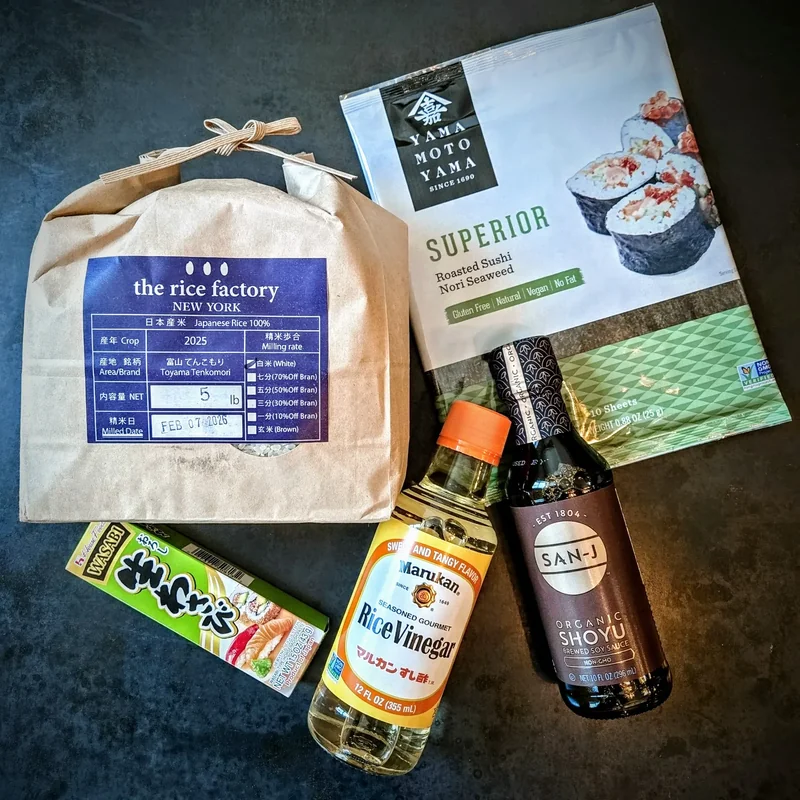
The Sashimi DC Home Sushi Kit — $50. Everything except the fish.
-
Sharp non-serrated knife A yanagiba (single bevel) is ideal. A sharp chef's knife also works. We offer professional knife sharpening in-store for customers — bring yours when you pick up your order.
-
Short-grain Japanese rice Freshly milled short-grain rice. Milling date matters — older rice loses moisture and doesn't absorb vinegar evenly.
-
Ready-to-use Sushizu (seasoned rice vinegar) Pre-mixed with the right sugar and salt balance for sushi rice. No measuring required.
-
Shoyu Small-batch brewed soy sauce. Mass-produced soy is too sharp and overwhelms delicate fish flavors. The difference is significant.
-
Nori Crisp, full-sheet Nori for Temaki. Cut into quarters with kitchen shears.
-
Wasabi paste Real wasabi root is ideal when available. High-quality paste is included in the Kit.
Day two
What to do with leftover sashimi.
Day-two sashimi is not a problem — it is an opportunity. Two traditional Japanese preservation techniques transform leftover fish into something distinct and often better than eating it fresh.
Zuke (soy marinade) — Microwave equal parts sake and mirin to cook off the alcohol. Cool completely, then add an equal part of soy sauce for a 1:1:1 marinade. Place leftover sashimi slices in a zip-lock bag with the marinade, refrigerate overnight. The next day: firm, deeply savory fish served over warm rice as Zukedon. Works especially well with Akami (lean Bluefin). Recipe and video on the Recipes page →
Kobujime (kelp cure) — Wipe two pieces of dry Kombu with a cloth lightly dampened with sake. Sandwich leftover white fish between them, wrap tightly in plastic, refrigerate 8–24 hours. The Kombu draws out moisture and transfers concentrated glutamates (umami) into the fish — firming the texture and deepening the flavor. Ideal for Madai (sea bream), Kanpachi, or Kinmedai. Recipe and video on the Recipes page →
Planning
When is the best time to order?
Sashimi DC receives Japanese fish shipments weekly. Fish arrives at Dulles Airport typically on Wednesdays, clears customs, and is available for pickup or delivery anytime while supplies last.
Thursday and Friday are the best days to order — stock is fully replenished right after Wednesday arrival. For weekend dinner parties, placing your order by Thursday is strongly recommended — popular cuts sell out by Saturday afternoon.
New arrivals and special seasonal items are announced via @keita_sashimi_dc on Instagram and the Updates blog.
Planning
How much fish should I order?
As a main course: 150–200g (5–7 oz) per person
As part of a spread with rice: 100–130g (3.5–4.5 oz) per person
Multi-fish home omakase: 80–100g of each variety for 2–3 people
When in doubt, lean toward ordering slightly more than you think you need. Leftover sashimi-grade fish keeps well for a second day and is easily transformed into Zuke or Kobujime.
For large parties or special occasions, call the shop directly at (202) 234-2737.
The fish
The cuts of Bluefin Tuna.
Bluefin Tuna from Goto, Nagasaki is available in four cuts that differ dramatically in fat content, texture, and flavor. All four are imported under NOAA SIMP regulations.
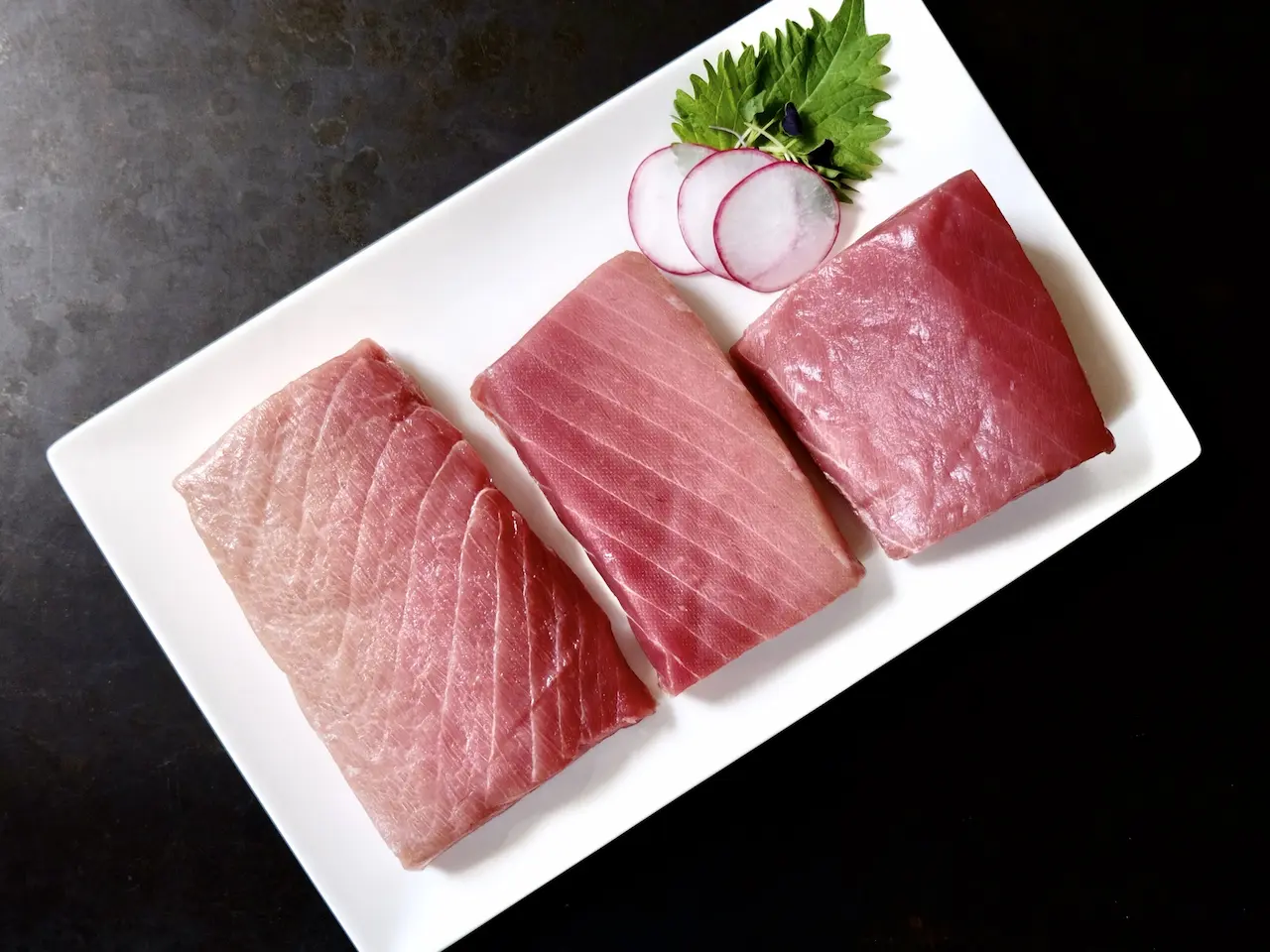
Left to right: Otoro, Chutoro, Akami — the full spectrum of Nagasaki Bluefin from Goto.
| Cut | Character | Best for | Price |
|---|---|---|---|
| Otoro大トロ · fatty belly | Highest fat content. Pale pink with heavy creamy marbling. Melts on the tongue. The most prized cut worldwide. | Sashimi, nigiri. Eat first while palate is fresh. | See shop |
| Chutoro中トロ · medium fatty | Medium fat with visible marbling. More structure than Otoro. Balances richness with a meaty, satisfying texture. | Sashimi, nigiri. Preferred by many experienced eaters for its balance. | See shop |
| Akami赤身 · lean loin | Deep red, minimal fat. Clean direct umami flavor. Firm, meaty texture. The traditional sushi bar tuna before Otoro became fashionable. | Sashimi, nigiri, Zuke (soy marinade). Excellent value. | See shop |
| Sujitoro筋トロ · sinew belly | Heavily marbled belly meat scraped from between sinew fibers — more intensely flavored and buttery than even the finest Otoro. Pockets of ultra-concentrated fat dissolve on the tongue. | Tartar, negitoro. The most intensely flavored cut. | See shop |
Beyond these four, rare cuts are occasionally available — Kama (collar), Hohoniku (cheek), Zuniku (head meat), and Nakaochi (rib-scraped) are exceptionally fatty and flavorful. These are announced via Instagram when available. They sell out quickly.
What to look for
What is CO treatment — and why does tuna color matter?
Carbon monoxide (CO) treatment is a practice used by some seafood wholesalers to preserve the color of tuna. CO reacts with myoglobin — the protein that gives tuna its red color — to form a stable compound that keeps the flesh vivid cherry-red for weeks, regardless of actual freshness. CO treatment is banned in Japan, the EU, and Canada. It is permitted in the US, and FDA does not require front-of-pack labeling.
The same practice exists beyond fish: beef, pork, and poultry in the US are widely packaged using Modified Atmosphere Packaging (MAP) with up to 0.4% CO, locking in a bright red color for 20–30 days. Most consumers are unaware of this.
How to spot untreated tuna: Sashimi DC's Akami is naturally dark red-purple — the true, unaltered color of fresh Bluefin Tuna. Vivid cherry-red tuna is almost always CO-treated. Dark color is not a defect; it is the correct color. Sashimi DC never uses CO treatment at any stage. About our Akami → · Full guide: CO treatment in tuna →
The fish
What is Ikejime — and why does it matter?
Ikejime (活け締め) is a traditional Japanese harvest technique for fish. The standard commercial alternative — leaving fish to suffocate in air or ice water — causes the fish to undergo extreme physiological stress. That stress triggers a cascade of hormones and lactic acid buildup in the muscle that degrades flavor and shortens shelf quality.
Ikejime has three steps: (1) Brain spike — the fish is instantly killed with a spike through the brain, ending stress immediately. (2) Exsanguination — the main blood vessels are cut and the fish is bled out in clean water. Blood is the primary source of off-flavors and bacterial growth. (3) Shinkei jime (神経締め) — a wire is threaded through the spinal canal to destroy the nervous system. This stops ATP consumption in the muscle, preventing rigor mortis from degrading texture and umami.
All Bluefin Tuna and Sasshu Salmon at Sashimi DC is Ikejime-processed at the source — Hosei Suisan in Nagasaki for tuna, Satsuma Sendai Unagi in Kagoshima for salmon. The result is firmer texture, cleaner flavor, and longer shelf quality compared to fish handled by conventional methods. Learn more at the Ike Jime Federation → · What is Ikejime? — full science →
The fish
Aging & umami: the biochemistry of the flavor window
When a fish dies, its muscles don't instantly become the food we eat. A cascade of biochemical changes unfolds — and understanding that cascade explains why Sashimi DC bluefin is often at its best two to four days after arrival, not the day it lands.
The process begins with ATP — adenosine triphosphate — the energy currency of living muscle. In a live fish, ATP is continuously replenished. At death, production stops, and the existing stores begin breaking down through a chain of enzymatic reactions: ATP → ADP → AMP → IMP → inosine → hypoxanthine. The critical step is IMP: inosine monophosphate is the primary umami nucleotide in fish, working alongside free glutamate to produce the deep savory flavor that defines great sashimi. IMP accumulates over the first several days post-harvest, peaks, then gradually depletes into inosine and hypoxanthine (which contribute bitterness). The umami window is real, and it has a shape.
Critically, this conversion is entirely autolytic — driven by the fish's own enzymes, not bacteria. A vacuum-sealed bluefin block stored at 1–2°C is not spoiling during this window; it is biochemically maturing. This is why 'consume immediately' advice, common for commodity fish, is not the right frame for ikejime-processed bluefin. The ikejime technique maximises the starting ATP reserve by preventing the pre-death struggle that would otherwise exhaust it. A fish killed by hypothermia or asphyxiation depletes much of its ATP before death. Ikejime preserves the full tank — which means the entire IMP peak is available downstream.
For Sashimi DC bluefin: fish arrives Wednesday and is available Thursday–Friday at peak stock. The vacuum pack and 15-day best-by window are your practical guides — the fish is improving through the first several days and holds quality well within that window. For Akami, which has less fat buffering the flavor, earlier in the week tends to show the brightest, cleanest character. For Otoro and Chutoro, the fat extends the peak longer.
Resting Sashimi DC bluefin: Remove from the vacuum pack only when you're ready to eat. Once opened, slice and consume immediately — enzymatic and oxidative processes accelerate rapidly on cut surfaces. Inside the sealed pack, the fish ages predictably. Outside it, the clock runs fast.
At home
Why does freezing damage fish?
Standard home freezers operate at around −18°C. At this temperature, water inside fish muscle cells migrates out of the cells before solidifying. Ice crystals form between cells and rupture cell membranes. When the fish thaws, the damaged cells leak flavor compounds and soluble proteins — what you see as the puddle of liquid (drip loss) under thawed fish. The result is a drier, softer, blander texture.
Fish oils — the omega-3 fatty acids (EPA and DHA) that make sashimi-grade fish nutritious — remain liquid until approximately −110°C. In a standard home freezer, they continue oxidizing slowly, building rancid off-flavors over time. This is why previously frozen fish has a duller, sometimes slightly 'off' taste compared to fresh.
Sashimi DC's Bluefin Tuna and Sasshu Salmon are never frozen at any stage — not by the processor, not in transit, not in our shop. The supply chain is engineered so that freezing is unnecessary: Ikejime processing in Japan, same-week airfreight to Dulles, cold-chain pickup by Keita personally. Fresh handling is how flavor and texture are preserved intact.
Nutrition
Is Bluefin Tuna healthy — what about mercury?
In appropriate portions, Bluefin Tuna is one of the most nutrient-dense proteins available. A 100g serving delivers 2.18g DHA + 0.693g EPA — exceeding the recommended daily intake for omega-3s in a single serving — along with 23g complete protein, 250% of daily Vitamin D, and 149% of daily selenium. The omega-3 to omega-6 ratio is 9:1. The fat marbling in Otoro and Chutoro is predominantly healthy unsaturated fat, not saturated fat. Full nutrition guide →
Like all tuna, Bluefin does contain mercury — primarily methylmercury, which bioaccumulates over a fish's lifetime. Sashimi DC's Goto Islands Bluefin is farm-raised from wild-caught juvenile seed stock (天然種苗) and harvested at 2–3 years. Farmed Pacific Bluefin from Japanese operations measures a median of ~0.40 mg/kg mercury in biopsied muscle (Takagi et al., 2025) — less than half the FDA action level of 1.0 µg/g, and significantly below wild adult Bluefin, which can exceed 1.0 µg/g. Farmed Bluefin also has a much better selenium-to-mercury ratio than wild-caught (5.48 vs. 1.32; Annibaldi et al., 2019), reducing effective risk further. Adults in good health can enjoy Bluefin in moderate quantities. Pregnant women, nursing mothers, and young children should follow FDA guidelines. Full guide: Mercury in Tuna →
Safety
Which fish are safe to eat raw — and why?
The primary parasite risk in raw fish is Anisakis, a nematode worm whose lifecycle runs through wild marine prey — krill, small fish — that marine animals eat. FDA HACCP regulations (21 CFR 123) address this two ways: (1) freezing wild-caught fish to −20°C for 7 days or −35°C for 15 hours destroys parasites; (2) fish raised on formulated feed without access to wild organisms are exempt — the infection pathway structurally does not exist.
Sasshu Salmon is raised in closed land-based tanks in Kagoshima fed by mineral groundwater — no ocean, no wild prey. Anisakis cannot enter the fish. Sasshu Salmon is served fresh, without FDA-required freezing. Hokkaido Uni (sea urchin) is not a fish and is not subject to the fish parasite rules at all — the risk with uni is bacterial spoilage from temperature abuse, not parasites. Hotaruika (firefly squid) can carry Anisakis in the viscera; Sashimi DC's hotaruika is lightly boiled at source in Japan — the standard preparation — which destroys parasites while preserving texture. Parasite Safety Guide → · Full Safety Guide →
The fish
What is uni — and what makes it bitter?
The golden lobes we eat are the gonads of the sea urchin — specifically the reproductive glands (testes or ovaries). These swell with nutrients in the weeks before spawning, which is when flavor is at its peak. The rest of the urchin's body is not consumed. Male uni (testes) tends toward deep reddish-orange with firmer lobes and more concentrated flavor. Female uni (ovaries) tends toward bright yellow with softer, creamier, more delicate flavor.
The bitterness that many people associate with uni is almost always caused by alum (ミョウバン) — a preservative widely used in the US seafood industry to firm uni texture and extend shelf life. Fresh, alum-free uni has a clean, sweet ocean flavor with no bitterness. Sashimi DC's Hokkaido Uni is not treated with alum, or treated with minimal alum.
Bafun Uni (馬糞) is smaller, with a more intense, concentrated sweetness and deep golden color — the premium variety. Murasaki Uni (紫) is larger, milder, creamier, and more delicate — an easier introduction for those new to uni. Both are sourced from Hokkaido. About our Hokkaido Uni →
What to look for
Wet vs. dry scallops — the phosphate problem.
Most scallops sold in the US are treated with sodium tripolyphosphate (STPP), a food additive that causes the muscle to absorb water and swell — sometimes increasing weight by 20–30%. This makes them look larger and more pristine, but the absorbed water cooks out as steam, causing significant shrinkage and preventing proper searing. You cannot get a golden crust on a wet scallop.
Japanese Hokkaido scallops are naturally untreated — no phosphate addition is made in Japan. They sear properly, develop a golden crust, and taste of the sea. When buying scallops elsewhere, look for labels that say 'dry scallops' or 'all natural' — both indicate no STPP. If the label just says 'fresh scallops' with no disclosure, assume treated. STPP must appear on the ingredient list under US labeling rules, but most seafood counters do not display ingredient lists prominently.
For everyone
Options for those who don't eat raw fish.
Not everyone at the table eats raw fish — and that is not a problem. Kagoshima Unagi Kabayaki is a fully cooked option from Sashimi DC: freshwater eel that has been split, steamed, grilled, and glazed with a sweet-savory tare sauce (soy, mirin, sake). No raw preparation required. It reheats in minutes and is one of Japan's most beloved comfort foods — the basis of Unadon (eel over rice) and Unaju (eel in a lacquer box).
Our Unagi comes from Daishin (大新) in Kagoshima — FSSC22000 certified, additive-free tare, traced from pond to product. $40 per piece. Available for same-day delivery across DC, Maryland, and Northern Virginia. About Kagoshima Unagi →
Pricing
How do tariffs affect fish prices?
We face cost increases not only from tariffs on Japanese imports but also from air cargo fuel surcharges and rising terminal charges at Dulles Airport. We try our best to absorb these costs — but have to pass some through to retail prices in order to continue delivering quality fish to our customers.
A full breakdown of the current tariff situation, fuel surcharge history, and terminal fee increases is on our Supply Chain & Import Costs page.
The fish
What is shun — Japanese fish seasonality?
Shun (旬) describes the peak season for a given ingredient — the period when flavor, fat content, and texture reach their natural apex. For fish, shun is driven by biology: spawning cycles determine when fat reserves are highest, and the best fish is eaten just before the spawn, when the body has stored maximum energy. For Bluefin Tuna, winter (December–February) is peak season — Akami becomes dense and layered with umami as fat migrates through the muscle. Summer Akami is brighter, with more acidity and lift. Neither is better; they are different registers of the same fish. Full guide to Japanese fish seasonality →
Pairings
Why does sake pair so well with raw fish?
Wine can create a metallic, fishy aftertaste with raw fish — the mechanism is Fe²⁺ ions in wine catalysing lipid oxidation in the fish's DHA-rich oils. Sake has almost no free iron compared to wine, which eliminates this reaction. Sake also delivers glutamate and IMP from koji fermentation, creating an additive umami effect with the fish's own IMP and free amino acids. At Rice Market, Sashimi DC's home venue, the sake collection runs to 100+ bottles — DC's largest portfolio, curated by Capital Sake. Full guide: sake and fish pairing →
The fish
Why does sashimi taste different from cooked fish?
Raw fish flavor is dominated by free amino acids and IMP — compounds that are heat-sensitive and partially destroyed by cooking. Glutamate and glycine drive the clean, sweet umami of raw tuna; DHA-rich fat creates a fatty, mouth-coating sensation distinct from cooked texture. The sensory lexicon for Bluefin Akami is metallic-forward (from myoglobin iron) and fibrous; Otoro is fatty and mouth-coating with almost no metallic note. Cooking converts IMP to inosine and hypoxanthine — flavor is simplified, the layered raw profile is gone. Full guide: the science of raw fish flavor →
For learners
Sashimi slicing & sushi-making classes.
Hands-on classes offered exclusively for Sashimi DC customers — free with purchase. Sashimi knife technique for adults, Temaki hand-roll making for families and kids.