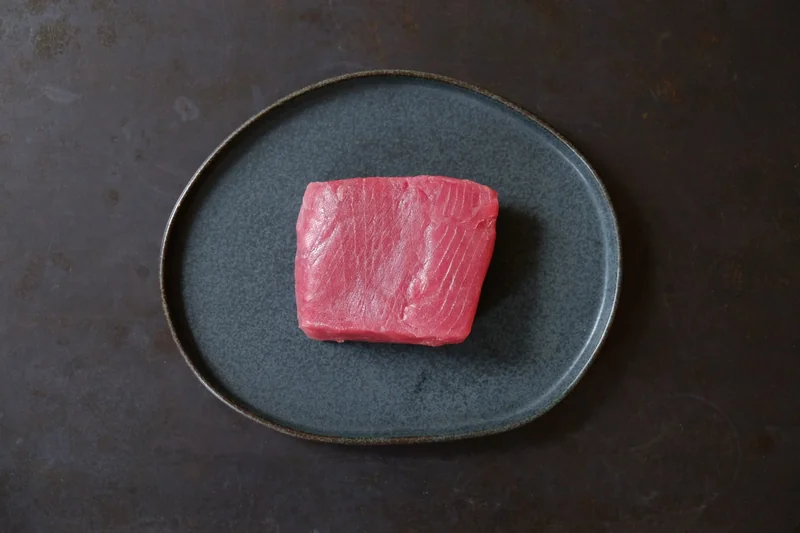
What is Akami?
Akami (赤身, “red body”) is the lean red muscle of the Bluefin Tuna — and the cut that defines the fish. Serious sushi lovers judge a restaurant by its Akami before anything else. Other tuna species have Akami cuts too, but Bluefin’s is in a different category entirely: the depth, the complexity, the finish. There is no comparison.
Akami from our Goto Islands Bluefin is intense in umami and well balanced with a subtle, natural acidity. It is considered top-quality even in Japan — the standard against which other Akami is measured. The flavor needs no ornamentation. A proper piece of Akami tells you everything about the fish it came from.
How foodies judge a sushi restaurant: Not by the Otoro, which fat can flatter. By the Akami — where there is nowhere to hide. Clean, vivid, long finish. If the Akami is right, the restaurant is right.
Sub-cuts of Akami
Each Akami cut (~8 oz) yields approximately 15 slices of sashimi — enough for 2–3 people as part of a shared meal or starter course.
Akami is not uniform across the fish. It yields from different blocks, each with its own texture and character. Sinews become progressively stronger toward the tail, and the block’s position on the fish changes how the cut feels and tastes.
Back · Middle
Senaka — 背中
The largest single source of Akami on the fish. The central back block yields the most consistent red meat — less sinewy than Sekami, broad and clean.
Back · Anterior
Sekami — 背上
My favourite Akami block. Next to the head, it carries fine texture and an elegant nuance of fat that Senaka does not have. More character, slightly richer in feel.
Near bloodline
Tenmi / Tempane — 天身
The strip of Akami running adjacent to the Chiai (bloodline), with few sinews. Prized for its clean texture. Sometimes called Tempane.
Toward tail
Tail-end cuts
Sinews strengthen progressively toward the tail. Cuts from this section require more careful preparation — or are used for Negitoro and scraped preparations where sinew is worked out by hand.
Seasonal character — summer vs winter
Akami changes more dramatically across seasons than any other cut. The difference is real enough that it is worth understanding before you order.
Summer Akami has a lifted quality — bright aroma, lively acidity, a certain lightness. The flavor is vivid rather than deep. Think of it as a light roast coffee: immediate, aromatic, clean on the finish.
Winter Akami is the dark roast. The cold water concentrates the fish’s energy into the muscle. Umami becomes thick and layered, the texture denser, the finish longer and heavier. This is the Akami that connoisseurs plan around — peak season for Goto Bluefin is the winter months.
Peak season: December through February. Winter Akami from Goto Islands Bluefin during these months is among the finest tuna available anywhere.
Color — what you should and should not see
When Akami is first cut from the block, it is a deep dark red-purple — almost maroon. As it is exposed to oxygen, myoglobin reacts and converts to oxymyoglobin, producing a darker ruby red. This is the natural color of properly handled sashimi-grade tuna. It is never vivid cherry-red or pink in its natural state.
Dark red-purple
Just cut from block
Deep ruby red
Natural, correct
Bright cherry red
CO-treated — avoid
Vivid pink
CO-treated — avoid
CO treatment — what it is and why it matters
Full explanation: the mechanism, Japan's 1997 MHLW ban criteria, and global regulatory status →
If you see bright cherry-red or pink tuna at a supermarket or fish counter in the US, it has almost certainly been treated with carbon monoxide gas — sometimes labeled “filtered wood smoke” or “tasteless smoke.” CO treatment is common in the US and banned in Japan.
The mechanism: CO reacts with the muscle pigment oxymyoglobin to form carboxy-myoglobin, a highly stable compound that permanently locks in a bright, watermelon-pink or cherry-red color. The fish looks vivid and fresh on the shelf for weeks rather than days. The color does not fade with age. The reaction is permanent.
Eating CO-treated tuna is not directly toxic. Breathing CO gas into your lungs is dangerous; eating meat where CO has bound to proteins is biologically harmless. The problem is different: CO treatment permanently strips away your ability to judge freshness by eye. A piece of CO-treated tuna three weeks old looks identical to one caught three days ago. If the fish was mishandled during transit — left at unsafe temperatures, bacterial buildup — it can carry dangerous toxins including histamine, which causes scombroid food poisoning, while looking completely picture-perfect. The visual signal that normally warns you of age has been chemically suppressed.
Our Akami is never CO-treated. The dark ruby color you see is the actual color of the fish in its actual condition. If it looks slightly darker than what you are used to seeing — that is what real Akami looks like.
CO gas treatment is not unique to fish. In the US, beef, pork, and poultry are widely packaged using Modified Atmosphere Packaging (MAP) — a sealed tray flushed with a gas blend that includes up to 0.4% carbon monoxide. The same chemistry applies: CO binds to myoglobin and locks in a bright, stable red color. Meat can remain cherry-red for 20–30 days on the shelf while bacterial levels continue to rise. The FDA classifies CO at this concentration as Generally Recognized as Safe (GRAS). The EU, Canada, and Japan have banned it on consumer deception grounds. The US has not.
There is also an educational dimension worth considering. A child who grows up seeing only CO-treated fish — and only CO-treated beef — learns the wrong lesson: that bright, vivid red equals fresh. That is not how biology works. Myoglobin darkens naturally as it oxidizes. Color change is the body’s honest signal. CO treatment chemically suppresses that signal across the entire American meat supply. It is worth knowing.
Read more: the mechanism, Japan's MHLW ban criteria, and global regulatory landscape →
How to eat it
Slice 10–12mm against the grain. A small amount of tamari, fresh wasabi. Nothing else is needed. The flavor does not require assistance.
For Zuke — the classic preparation of briefly marinating Akami in soy and mirin — this is the traditional cut for a reason. The marinade’s salt concentration is higher than the fish’s own fluids, so osmosis draws moisture out of the flesh — carrying off some of the compounds responsible for "fishy" off-notes along with it. As moisture leaves, amino acids and other umami compounds from the marinade move into its place. The salt also firms the muscle’s myofibrillar proteins, improving water retention, and the elevated salt concentration suppresses the microbial activity responsible for spoilage. Zuke Akami pairs exceptionally well with aged Pinot Noir. See the recipes page for guidance.
For guests who prefer salmon to tuna, our sashimi-grade salmon — Sasshu Salmon from Kagoshima — is land-raised, ikejime-processed, and never frozen.
Where this fish comes from
Every piece of Bluefin Tuna at Sashimi DC comes from Hosei Suisan (宝生水産), a farm in the Kamishima Wakamatsu area of the Goto Islands, Nagasaki Prefecture — the westernmost islands of Kyushu, where the Pacific and East China Sea converge.
The Goto Islands maintain water temperatures that never fall below 13°C in winter and rarely exceed 29°C in summer — the stable, narrow range that Bluefin Tuna require for consistent growth and quality. Hosei Suisan operates in the Kamishima Wakamatsu area, one of the most environmentally favored zones for marine aquaculture within the islands.
Hosei Suisan uses wild-caught seed stock (天然種苗) rather than hatchery-bred fish. Feed is sourced fresh and locally, centered on fresh mackerel (生サバ) bought directly by their own trucks from local fishermen. Director Tsuneya Yamashita explains the choice: mackerel produces better fat marbling and color than sardines. As mackerel catches have declined and prices risen in recent years, they secured dedicated year-round supply agreements with their fishing partners to maintain the standard. Post-harvest handling — the initial processing and preparation after the fish is landed — is also a focus: Ikejime is performed in Nagasaki, at source.
Two-time award winner: Hosei Suisan won the top prize (最優秀) at the Nagasaki Prefecture Farmed Bluefin Tuna competition twice — once in December 2014, and again on December 8, 2023 — showcasing the fish from Japan’s leading farmed Bluefin production prefecture.
After Ikejime processing in Nagasaki, the fish is transported to a specialist Miyazaki processor where it is broken down into saku blocks, then flown Fukuoka → Haneda → IAD.
Sashimi DC is certified as a Japanese Food and Ingredient Supporter Store by Japan's Ministry of Agriculture, Forestry and Fisheries (MAFF), administered by JETRO (Certification ID: J000-001-410, valid through May 2028). One of three certified establishments in Washington DC (the others are Sushi Taro restaurant and, as of August 2026, DC Sake Co) and the only certified fish retail counter in the city.
Ikejime — the considered kill
Most harvested fish die by suffocation. Removed from water, they slowly asphyxiate. The stress hormones released during that process — combined with temperature mismanagement — degrade the flesh before it ever reaches a kitchen. Lactic acid accumulates. Texture deteriorates. The smell that people associate with “fishy” fish is, in large part, the smell of stress. · What is Ikejime? — full science →
Ikejime (活け締め) is the opposite: a considered kill. The fish is dispatched instantly via a brain spike, stopping all stress signals immediately. This is followed by exsanguination (bleeding out) and spinal cord destruction — a technique called shinkei jime (神経締め) — which halts all neurological activity and prevents further ATP consumption in the muscle. The result is meat with superior texture, extended shelf quality, and the deep umami that makes sashimi-grade fish worth eating. Learn more at the Ikejime Federation.
The latest refinement in Japan: The leading edge of ikejime practice now incorporates a conditioning step before the kill. In Ehime Prefecture, select fishermen hold live fish in low-oxygen seawater immediately after catch, waiting until all physical tension has fully dissipated from the muscles. Only then is the ikejime performed. The effect: the flesh maintains its texture and quality for significantly longer than standard ikejime. This technique is practiced by very few — in some areas, fewer than two fishermen.
Certified by Japan’s MAFF
Sashimi DC is certified as a Japanese Food and Ingredient Supporter Store by Japan's Ministry of Agriculture, Forestry and Fisheries (MAFF), administered by JETRO (Certification ID: J000-001-410, valid through May 2028). One of three certified establishments in Washington DC, including Sushi Taro and DC Sake Co (see the embassy’s list of certified businesses), and the only certified fish retail counter in the city.