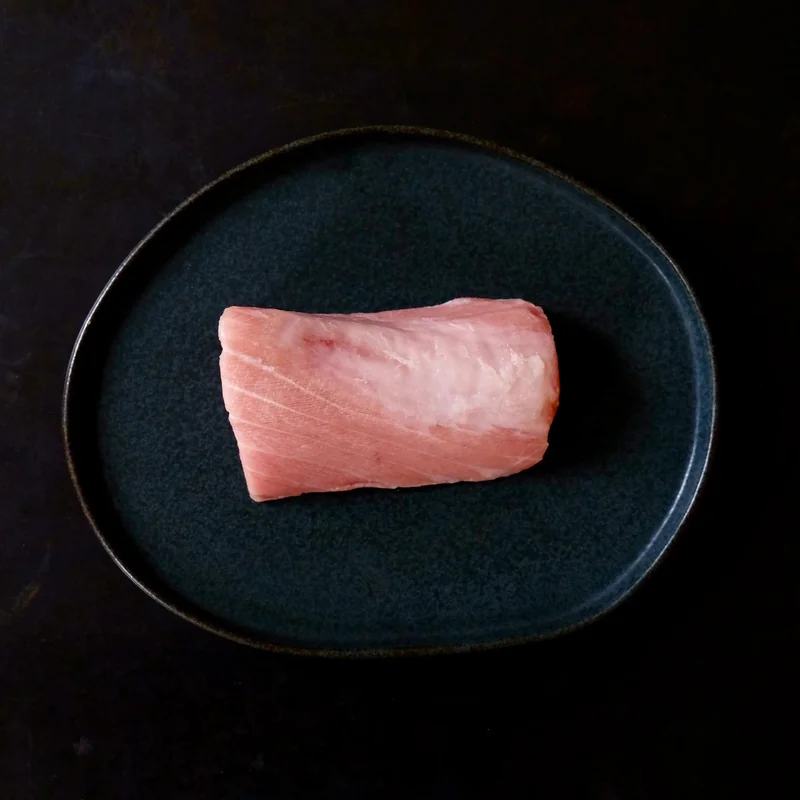
Can I buy Sujitoro (Bluefin Tuna Negitoro cut) in Washington DC?
Yes — Sashimi DC carries Sujitoro from Goto Islands, Nagasaki — sinew-threaded Bluefin Tuna used for pure Negitoro and Hagashi Chutoro. Ikejime-processed, never frozen, flown direct from Japan. Available in-store at 1608 14th St NW, DC (inside Rice Market) and same-day delivery across DC, Virginia, and Maryland.
What is Sujitoro?
Sujitoro (筋トロ / スジトロ) is Bluefin Tuna meat from sections around the backfin, running through strong sinews — sometimes called Teppo-suji (鉄砲筋, "gun sinews") for their rigidity. The sinews are too chewy to eat raw in a sashimi slice. But the meat surrounding them is among the most marbled and intensely flavored on the entire fish.
The cut is also known as Wakaremi (分かれ身) — "split body" — because the block can be divided cleanly along the sinew lines. In flatfish like Hirame and Karei, the equivalent is called Engawa. Same structural idea: peripheral muscle near the fin, lots of connective tissue, exceptional flavor.
Because it cannot be served as standard sashimi slices, Sujitoro is processed by one of two methods: scraping for Negitoro, or peeling (Hagashi) for sashimi-grade pieces.
Method 1 — Negitoro: scraping the meat
The most common use. By scraping the meat away from the sinews with the back of a knife, you yield a smooth, intensely flavored tartare — Negitoro (ネギトロ). In Japanese sushi culture, Negitoro is traditionally mixed with scallion (negi) and served on rice as Negitoro-don, or as a gunkan roll.
The name Negitoro has two claimed origins: negi (ネギ, scallion) or the verb negu (ねぐ, to scrape). Both are plausible; the scraping etymology is particularly apt here.
What Negitoro often is not: At non-specialist restaurants, Negitoro is frequently not pure Bluefin Tuna tartare. The scraped yield from premium tuna is small and expensive, so many operations use lower-grade tuna, other fish species, or no tuna at all — padded with added fat or oil to mimic the texture of fatty tuna. Some use CO treatment to achieve a bright color (Japan's Ministry of Health and Welfare, 1997; sources). Pure Bluefin Tuna tartare needs none of this. The flavor of the fish carries it entirely.
Scraping Sujitoro for Negitoro is the traditional entry-level task for junior chefs in sushi restaurants — time-consuming but essential. We run Negitoro-making classes at Sashimi DC (lower floor of Rice Market), and there is a Negitoro preparation video on the recipes page.
Sujitoro vs. Nakaochi: which is fattier?
Both make pure Bluefin Negitoro, but they differ in fat. Nakaochi — meat scraped from the rib bones — is the leaner of the two, close to Akami in fat content, and arrives already loose and sinew-free. Sujitoro is much fattier: its marbled meat gives Negitoro a richer, more luscious flavor, but you scrape it away from the sinews yourself. Choose Nakaochi for a lighter, ready-to-mix Negitoro; choose Sujitoro for maximum fat and flavor, or to try Hagashi Chutoro or cooking.
Method 2 — Hagashi: peeling sashimi-grade meat
The second approach is more demanding. In the Sekami section (背上 — the back block adjacent to the head), the Sujitoro layers are thicker. By peeling (hagasu — 剥がす) the meat away from the sinew in long, deliberate strokes, you can yield pieces thick enough to serve as sashimi — completely free of sinew.
The result, Hagashi Chutoro, is one of the most exceptional expressions of Bluefin Tuna. Even smoother than standard Chutoro — the fat-to-flavor balance is superb, and the texture almost silken. It is labor-intensive work, but the Sekami (背上) section of a good Sujitoro piece rewards the effort.
Method 3 — Cooking: the collagen transforms
The sinews that make Sujitoro unsuitable for raw slicing are built from collagen. When heated to around 55–60°C, that collagen breaks down and dissolves — the formerly chewy strands become tender, gelatinous, and deeply savory. Cooking unlocks a completely different character in the same cut.
Keita's favorite preparation is Tatsuta-age (竜田揚げ) — a Japanese-style marinade and deep-fry that produces a crisp exterior and rich, yielding interior. These recipes all work particularly well with Sujitoro: Firecracker Bluefin Tuna, Bluefin Tuna Kyiv, and Bluefin Tuna Bolognese.
Where this fish comes from
Every piece of Bluefin Tuna at Sashimi DC comes from Hosei Suisan (宝生水産), a farm in the Kamishima Wakamatsu area of the Goto Islands, Nagasaki Prefecture — the westernmost islands of Kyushu, where the Pacific and East China Sea converge.
The Goto Islands maintain water temperatures that never fall below 13°C in winter and rarely exceed 29°C in summer — the stable, narrow range that Bluefin Tuna require for consistent growth and quality. Hosei Suisan uses wild-caught seed stock (天然種苗) and feeds primarily on fresh mackerel (生サバ) sourced directly from local fishermen — a deliberate choice for fat marbling and color.
Two-time award winner: Hosei Suisan won the top prize (最優秀) at the Nagasaki Prefecture Farmed Bluefin Tuna competition twice — once in December 2014, and again on December 8, 2023 — showcasing the fish from Japan’s leading farmed Bluefin production prefecture.
After Ikejime processing in Nagasaki, the fish is transported to a specialist Miyazaki processor where it is broken down into saku blocks, then flown Fukuoka → Haneda → IAD. It reaches the Sashimi DC counter approximately 48 hours from Miyazaki — never frozen, never CO-treated.
Prefer a milder sashimi? Our sashimi-grade salmon is a tank-raised Sasshu Salmon from Kagoshima — Ikejime-processed and never frozen.
Sashimi DC is a MAFF-certified Japanese Food and Ingredient Supporter Store (ID J000-001-410) — the only certified fish retail counter in Washington DC. See the embassy’s list of certified businesses.