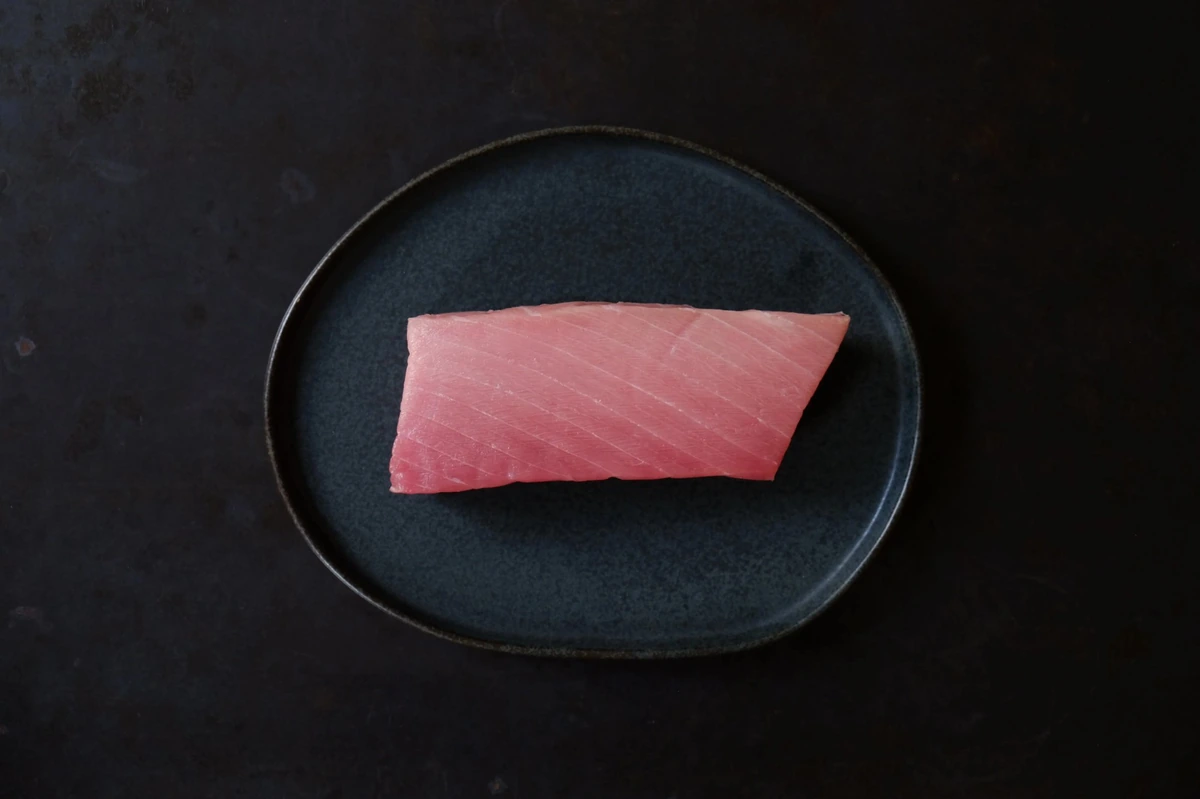
What is Chutoro?
Chutoro (中トロ, "medium fatty tuna") comes from the upper belly and back-adjacent areas of the Bluefin — a transitional zone where fat and lean muscle interleave in roughly equal measure. It is neither the direct intensity of Akami nor the melting richness of Otoro: it is the point where the two converge.
On a fish of the quality produced by Hosei Suisan, Chutoro is arguably the most interesting cut. The fat contributes silkiness and richness; the lean muscle beneath it carries umami that pure Otoro cannot achieve alone. This is why Chutoro is the cut we recommend to first-time buyers.
First-time recommendation: Start with Chutoro. It gives you richness and umami simultaneously. From there, you’ll know whether you want more fat (Otoro) or more lean intensity (Akami).
Chutoro changes with the seasons: winter fish (peak December–February) carry heavier marbling, while summer fish run leaner with brighter acidity. Both are excellent — different in character, not quality. The Japanese concept of shun explains why.
Sub-cuts of Chutoro
Chutoro is not a single uniform cut — it is a category that spans four distinct blocks of the fish, each with its own character. Understanding these differences explains why Chutoro from the belly can taste so different from Chutoro cut from the back.
Belly · Anterior
Harakami — 腹上
The belly block directly behind the collar. Highest fat content of any Chutoro block — a significant portion yields Otoro, with Chutoro toward the edges. Contains the most intense Chiaigishi sub-cuts.
Belly · Middle
Haranaka — 腹中
The central belly block. Similar profile to Harakami but more balanced: more Chutoro, less Otoro. The center of the block yields the most representative and evenly marbled Chutoro on the fish.
Back · Anterior
Sekami — 背上
The back block adjacent to the collar. More sinewy than belly cuts, especially near the dorsal fin. Yields Chutoro where sinew is light; heavier sinew sections are worked using the Hagashi technique.
Back · Middle
Senaka — 背中
The central back block. The highest proportion of Chutoro of any block on the fish, and less sinewy than Sekami. Contains the Wakaremi sub-cut adjacent to the dorsal fin.
Chiaigishi — the bloodline-adjacent sub-cut
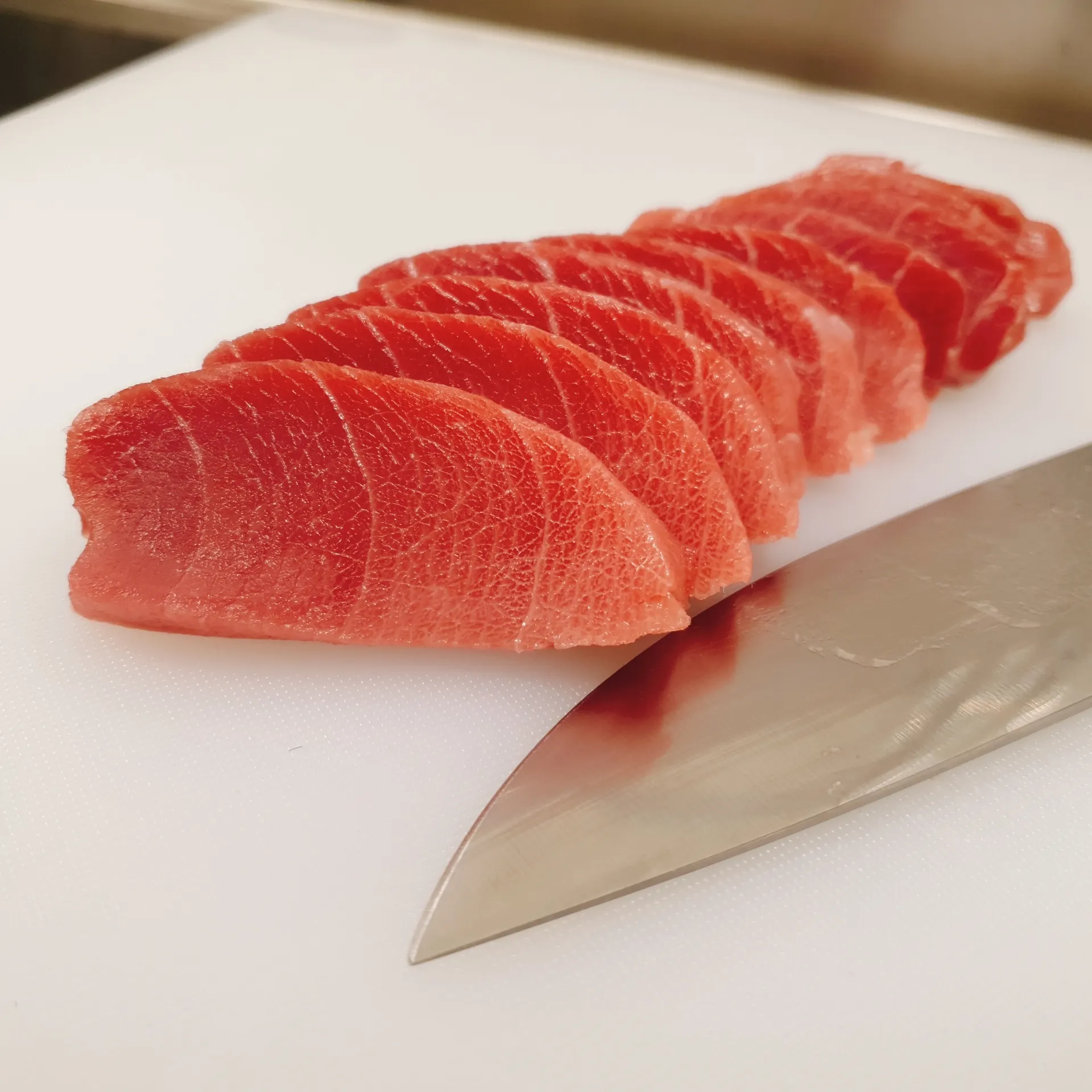
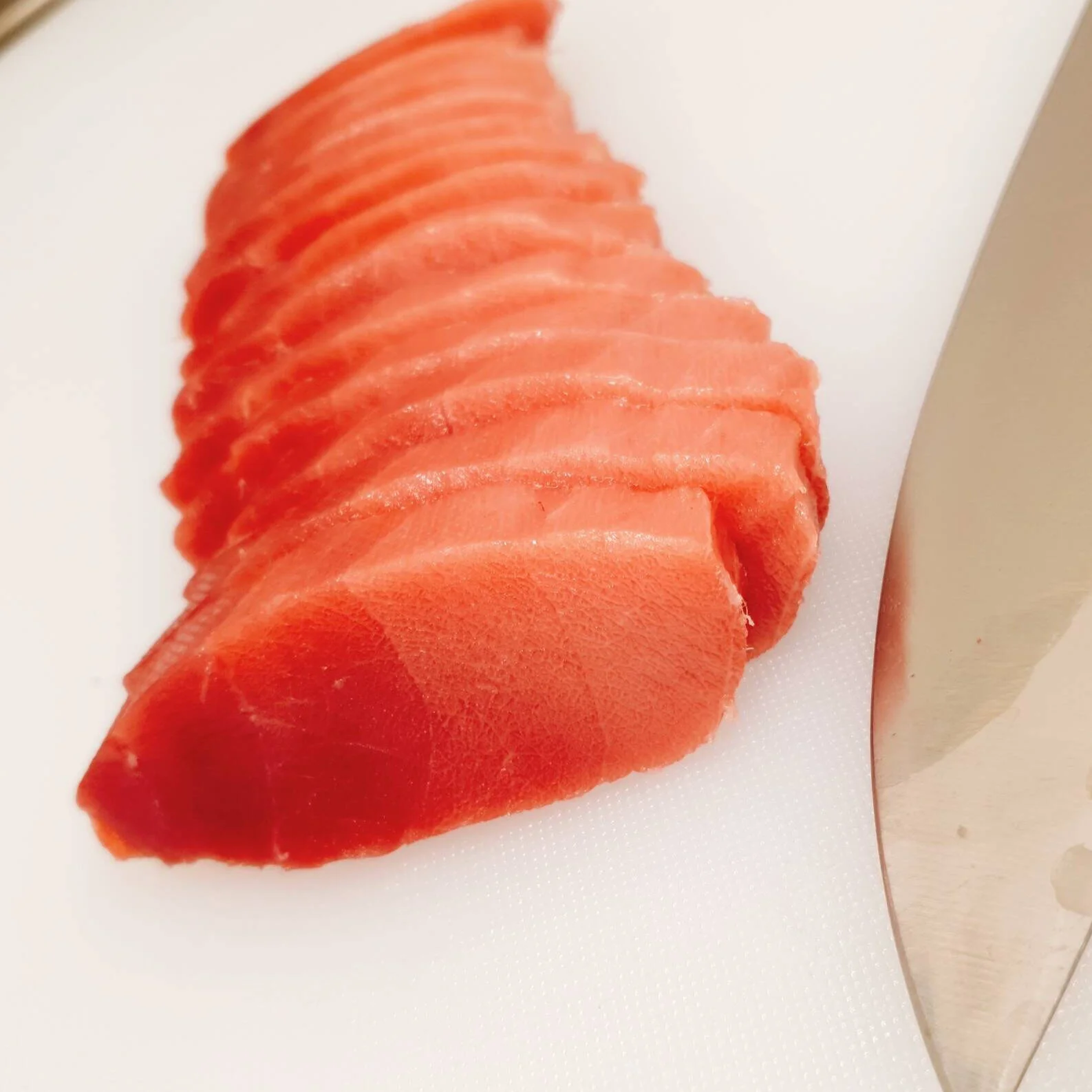
Within both Harakami and Haranaka, the narrow band of meat running alongside the Chiai (bloodline) is called Chiaigishi. It is the darkest-colored section in the Chutoro zone and carries the most concentrated umami of any Chutoro sub-cut — while still maintaining the silky fat that defines the belly cuts. Moving away from the bloodline toward the outer belly, color transitions from deep red to near-white as fat content increases and the meat approaches Otoro in character, with fine marbling throughout. Harakami Chiaigishi is more intense than Haranaka Chiaigishi.
Hagashi — peeling from the sinew
In sections of Sekami where connective tissue is too dense to slice cleanly, we use the Hagashi technique: the layer of meat is carefully peeled away from the sinew network by hand rather than cut through it. The result is a piece entirely free of sinew — with a tenderness that rivals the belly cuts, but the stronger, more direct flavor characteristic of back meat. Hagashi is time-consuming work and the yield from each fish is small.
Wakaremi — the wrapped sub-cut of Senaka
Wakaremi sits at the dorsal fin edge of the Senaka block, enclosed within a band of strong sinew. Untrimmed, Wakaremi may be sold as Sujitoro — the sinew gives it a looser, pulled texture. Trimmed of its outer sinew layer, the interior is completely tender and carries a texture very similar to Hagashi Chutoro from Sekami: concentrated, fine-grained, with no resistance. When Wakaremi is offered by name at Sashimi DC, it has been properly trimmed.
How to eat it
8–10mm, Hira-zukuri, against the grain. Slice cold and allow 2–3 minutes on the plate before eating. As nigiri, the warmth of the rice gently melts the fat from below. Chutoro also takes well to light torching (Aburi) — a brief pass of a kitchen torch caramelizes the fat on the surface while leaving the interior raw. If a guest prefers a milder fish, Sasshu Salmon is a land-raised alternative from Kagoshima, ikejime-processed and never frozen.
Where this fish comes from
Every piece of Bluefin Tuna at Sashimi DC comes from Hosei Suisan (宝生水産), a farm in the Kamishima Wakamatsu area of the Goto Islands, Nagasaki Prefecture — the westernmost islands of Kyushu, where the Pacific and East China Sea converge.
The Goto Islands maintain water temperatures that never fall below 13°C in winter and rarely exceed 29°C in summer — the stable, narrow range that Bluefin Tuna require for consistent growth and quality. Hosei Suisan operates in the Kamishima Wakamatsu area, one of the most environmentally favored zones for marine aquaculture within the islands.
Hosei Suisan uses wild-caught seed stock (天然種苗) rather than hatchery-bred fish. Feed is sourced fresh and locally, centered on fresh mackerel (生サバ) bought directly by their own trucks from local fishermen. Director Tsuneya Yamashita explains the choice: mackerel produces better fat marbling and color than sardines. As mackerel catches have declined and prices risen in recent years, they secured dedicated year-round supply agreements with their fishing partners to maintain the standard. Post-harvest handling — the initial processing and preparation after the fish is landed — is also a focus: Ikejime is performed in Nagasaki, at source.
Two-time award winner: Hosei Suisan won the top prize (最優秀) at the Nagasaki Prefecture Farmed Bluefin Tuna competition twice — once in December 2014, and again on December 8, 2023 — showcasing the fish from Japan’s leading farmed Bluefin production prefecture.
Quality control — a real example
In one early shipment, Chutoro blocks arrived with the white marbling intact but the surrounding pink flesh looking duller than usual — not off in flavor or texture, but visually below what we expect. Keita flagged it to the processor directly.
The cause was identified within hours: Hiyashikomi — the post-harvest icing protocol applied at the farm — had not been as rigorous as standard that week. The processor corrected the protocol immediately. The same issue has not recurred. This is what a direct relationship with the processor actually means: the observation travels one hop, the fix happens at source, and the next shipment is better.
Why Akami doesn't look cherry-red. Some Akami at other counters is a vivid cherry-red — that is almost always CO treatment, which reacts with myoglobin to lock in the color regardless of actual freshness. Our Akami is naturally dark red-purple. The Hiyashikomi incident above is the reason we know the difference: we caught a subtle color deviation in Chutoro through direct processor communication. We are paying attention to color — and we know what the correct color looks like.
After Ikejime processing in Nagasaki, the fish is transported to a specialist Miyazaki processor where it is broken down into saku blocks, then flown Fukuoka → Haneda → IAD. Full supply chain and quality control record: Supply Chain & Import Costs · What is Ikejime? →.
Sashimi DC is certified as a Japanese Food and Ingredient Supporter Store by Japan's Ministry of Agriculture, Forestry and Fisheries (MAFF), administered by JETRO (Certification ID: J000-001-410, valid through May 2028). One of three certified establishments in Washington DC (the others are Sushi Taro restaurant and, as of August 2026, DC Sake Co) and the only certified fish retail counter in the city.
Certified by Japan’s MAFF
Sashimi DC is certified as a Japanese Food and Ingredient Supporter Store by Japan's Ministry of Agriculture, Forestry and Fisheries (MAFF), administered by JETRO (Certification ID: J000-001-410, valid through May 2028). One of three certified establishments in Washington DC, including Sushi Taro and DC Sake Co (see the embassy’s list of certified businesses), and the only certified fish retail counter in the city.