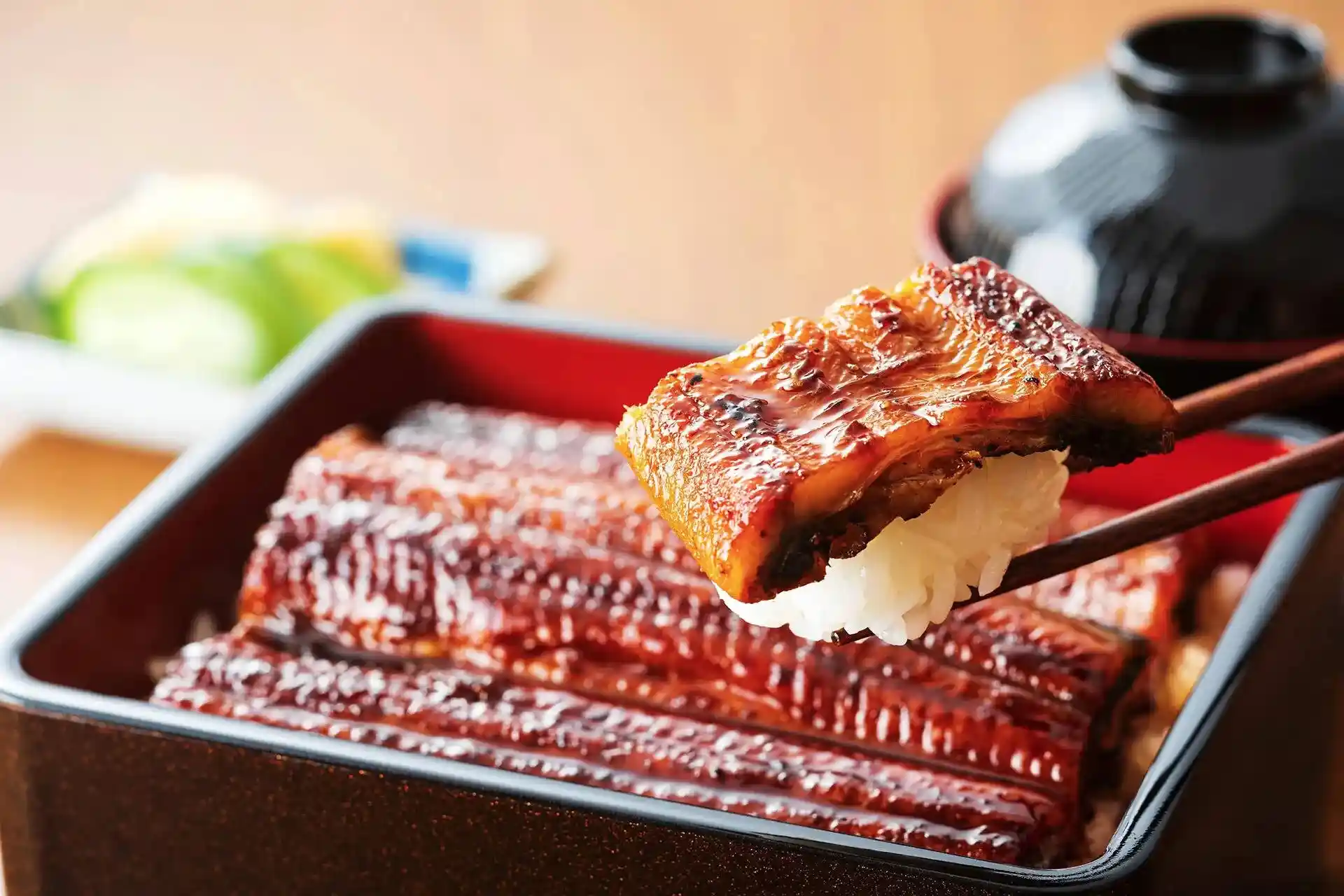
Where can I buy authentic Japanese unagi kabayaki in Washington DC?
Sashimi DC at Rice Market (1608 14th St NW) carries Daishin Unagi Kabayaki from Kagoshima — FSSC22000-certified, processed on a 90-meter steam line, glazed with additive-free tare (no artificial colorings, preservatives, or MSG). Winner of the Japan Food Selection Grand Prix, December 2025. $40/pc. Available for pickup daily or same-day delivery across the DC metro area.
What is Unagi Kabayaki?
Unagi Kabayaki (うなぎ蒲焼) is the definitive preparation of Japanese freshwater eel — split, skewered, steamed to open the flesh, then grilled over charcoal and repeatedly glazed with a sweet-savory tare of soy, mirin, and sake. The result is lacquered, deeply fragrant, with tender flesh and a caramelized crust that is unlike anything else in Japanese cuisine.
In Japan, unagi is serious business. The best kabayaki specialists operate for generations, with tare pots never fully emptied — the same sauce replenished and aged over decades. The Doyo no Ushi no Hi tradition (midsummer eel day) drives national consumption every July. At the counter or in a lacquer box over rice, kabayaki is one of the great pleasures of the Japanese table.
Looking for the best Unadon in Washington DC? Sashimi DC's Daishin kabayaki — additive-free tare, 90-meter steam line — is what home cooks across the city use to make it. Unadon vs. Unaju: both are kabayaki over rice. Unadon (丼) serves it in a bowl; Unaju (重) in a lacquered box (jubako). The kabayaki itself is identical — the vessel signals formality.
Three things that define Daishin’s Kabayaki
Most frozen kabayaki sold in the US — at Japanese supermarkets or online — comes from large commodity processors where uniformity, shelf life, and margin are the priority. Daishin is built around a different set of values: a specific sourcing area, a specific production philosophy, and a certification framework that makes claims verifiable.
01
良質な原料 — Quality Raw Material
Only Kagoshima-farmed eel from designated farms on the Shirasu Plateau. The volcanic plateau's groundwater feeds the farms with mineral-rich water. Daishin operates its own farm within the group — and purges each eel in 150-meter deep artesian spring water from Ibusuki for 24 hours before processing, firming the flesh and removing any muddy character.
02
じっくり丁寧な焼き — Slow, Careful Grilling
Daishin's white-grilling line (白焼きライン) is longer than the industry standard, running at high temperature to slowly render excess fat while preserving the eel's own umami. After white-grilling, the eel passes through a 90-meter steaming line — one of the longest in the world — which eliminates size variation and produces uniformly fluffy, thick flesh across every piece. Final tare-grilling repeats three times, with a finishing coat applied last.
03
秘伝のたれ — Proprietary Additive-Free Tare
The tare uses 100% domestic hon-mirin and honjozo koikuchi soy sauce — no artificial colorings, no preservatives, no MSG or chemical flavor enhancers. Daishin developed this recipe jointly with a specialist manufacturer specifically to avoid the additives common in mass-market kabayaki. The result: genuine depth, restrained sweetness, long umami finish.
What’s in most supermarket kabayaki — and what’s not in Daishin’s
Most frozen unagi sold at US grocery chains and online retailers contains additives that Daishin deliberately excludes. Daishin’s own materials define three categories of concern: colorings (used to standardize the glaze appearance), preservatives (for shelf life), and chemical flavor enhancers such as MSG or its derivatives. None of these appear in Daishin’s tare or production process.
| Ingredient / Additive | Daishin (Sashimi DC) | Typical brand A* | Typical brand B* |
|---|---|---|---|
| Eel origin | Kagoshima, Japan | Origin not disclosed | China |
| Soy sauce | Honjozo koikuchi (naturally brewed) | Soy sauce | Soy sauce |
| Mirin | 100% domestic hon-mirin (glutinous rice, rice koji, shochu) | Sugar + glucose syrup | Water + glucose syrup + modified starch |
| Artificial coloring | None | None | Caramel color, Annatto |
| Chemical flavor enhancers | None | Yeast extract | Disodium inosinate, disodium guanylate |
| Thickeners / gelling | Agar, starch (natural) | Agar, starch | Xanthan gum, modified starch |
| Industrial alcohol | None | None | Ethyl alcohol |
* Ingredient data from labels of unagi kabayaki products sold via Weee! (US online Asian grocery), June 2025. Brand names withheld. Formulations may vary by lot.
On agar and starch in Daishin’s tare: These appear in the ingredient list as natural thickeners and gelling agents — not as colorings, preservatives, or flavor enhancers. Daishin’s stated commitment is the absence of those three specific categories. The tare contains no artificial colorings, no preservatives, and no chemical flavor enhancers (MSG or equivalent).
Japan Food Selection — Grand Prix, December 2025
In December 2025, Daishin’s kabayaki was awarded the Japan Food Selection Grand Prix — a national food quality award evaluated by a panel of culinary professionals and nutritionists. It is one of the more credible third-party quality signals in the Japanese packaged food industry, covering taste, safety, and production standards. This is the producer Sashimi DC sources from.
FSSC22000 — What the certification means
Most food products — even premium ones — are produced under basic HACCP or domestic food safety standards. Daishin holds FSSC22000, the international food safety system certification based on ISO22000:2018, the highest tier of food safety management recognized globally. It covers the entire manufacturing process: raw material intake, processing, packaging, storage, and dispatch.
What this means in practice: external auditors verify Daishin's hygiene controls, risk management procedures, and traceability documentation at regular intervals. The farm-to-product chain — pond entry date, feed records, processing date, lot number — is documented at every step and retrievable on demand. This is the same certification standard used by producers supplying major international retailers and airline catering. It is not common for artisan kabayaki producers.
Full traceability: Daishin can trace any piece of kabayaki back to the specific farm, pond, and production lot. This is the food safety standard Keita requires for everything carried at Sashimi DC.
The Shirasu Plateau — why Kagoshima eel is different
The Shirasu Plateau (シラス台地) is a volcanic ash plateau covering much of Kagoshima Prefecture — the product of ancient pyroclastic flows from Sakurajima and the Aira Caldera. Its geology creates a specific water chemistry: the aquifer is mineral-rich, low in organic matter, and exceptionally clean. These conditions have made Kagoshima one of Japan's premier eel-farming regions for generations.
Eel is sensitive to water quality in a way that makes terroir a meaningful concept. The same species farmed in different water conditions — different mineral balance, different temperature profile, different dissolved oxygen levels — produces meaningfully different flesh. Kagoshima eel raised on Shirasu Plateau water develops well-distributed fat, clean flavor, and firm texture. Daishin has farmed in this region for decades and sources exclusively from designated farms within it.
How to serve it
Defrost overnight in the refrigerator. The most common preparation is Unadon — kabayaki served over hot short-grain rice in a bowl, with a drizzle of tare and a pinch of sansho pepper. Simple, complete, one of the great meals.
What’s in one piece
One piece of Daishin Unagi Kabayaki is about 220 g — enough for two bowls of Unadon, since a typical serving is 100–150 g. It arrives frozen in a vacuum pack and fully cooked: thaw overnight in the fridge, then reheat in the sealed pack. No knife work and no raw preparation, which makes it the easiest first step into Japanese home cooking.
Reheating
Hot water bath (recommended): once thawed, leave the kabayaki in its original vacuum-sealed pack and submerge in boiling water for 2–3 minutes. This is the best method for preserving the fluffy, tender texture — no moisture loss, no surface drying. Remove from the pack and serve immediately.
Pan method (alternative): place skin-side down in a lightly oiled pan over medium heat for 2–3 minutes, flip briefly for 30 seconds. Oven method: wrap in foil, 350°F for 8–10 minutes.
Beyond Unadon
Kabayaki is also excellent in Hitsumabushi style — chopped fine and served over rice in three passes: plain, with condiments (wasabi, nori, scallion), then dashi poured over. Or sliced cold into thin strips and used as a topping for chilled soba. The tare-glazed surface pairs exceptionally well with a dry junmai sake or, counterintuitively, a mineral-driven Chardonnay.
Storage: Keep frozen until use. Once defrosted, consume within 2 days. Do not refreeze.
Why we carry it
Kagoshima Unagi Kabayaki is our highest-volume product by units sold. The repeat purchase rate is higher than any other item we carry. The practical reasons: it reheats in three minutes (vacuum pack in boiling water), it requires no knife work, and the quality gap between Daishin and what is available at Japanese grocery stores in the DC area is not small. Daishin's additive-free tare — no artificial colorings, no MSG, no preservatives — also makes it one of the cleaner prepared Japanese proteins available. It is the easiest high-quality Japanese dish to make at home.
Keita sources directly from Daishin in Kagoshima — the same supply relationship that underlies every product at Sashimi DC: find the best producer in the specific region, verify their standards, and bring it here without the intermediary markup or quality dilution that comes with conventional distribution.
Eel is also the root of another Kagoshima exclusive: Sasshu Salmon is raised by Satsuma Sendai Unagi, a longtime eel-farming specialist that applied the same water-quality discipline to sashimi-grade salmon. If you buy kabayaki for the family, that salmon is the raw-fish counterpart worth trying.