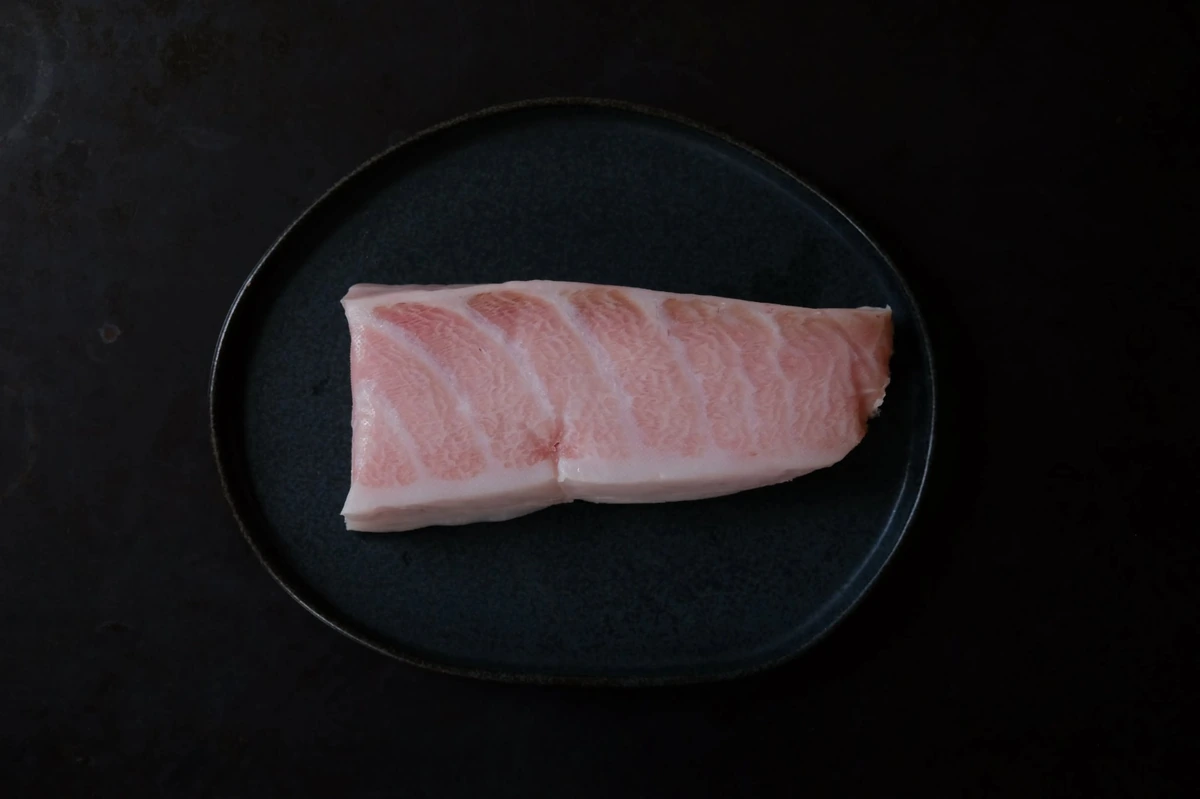
What is Otoro?
The Bluefin Tuna belly is not a single cut — it is a continuous gradation. From the outermost edge of the belly flap through to the border with Chutoro, fat content, texture, and flavor character shift progressively. What most counters label as a single "Otoro" product is one point on a spectrum. At Sashimi DC, we make that spectrum available.
Harakami (腹上) is the name of the belly block located adjacent to the collar and head — the forward section of the ventral belly. From a Harakami block, you might expect roughly 15% Akami, 15% Chutoro, and 70% Otoro by weight. Within that Otoro portion, the outermost belly edge is Jabara — with its distinctive fat architecture and pronounced sinews — and as you move inward toward the Chutoro border, the texture becomes progressively finer and more evenly marbled. We call this inner section marbling Otoro. There is no universal industry name for it; it is the quiet middle of the spectrum, and it is often the most nuanced of the three.
Understanding this gradation is what separates a knowledgeable fish buyer from someone simply paying an Otoro premium without knowing which part they are eating. If you have a preference — Jabara's fat architecture versus the finer marbling cuts — tell us at pickup.
Sub-cuts of Otoro
Collar Otoro · Highest fat content on the fish
Kamatoro — カマトロ
Cut from the Kama — the collar section immediately behind the head — Kamatoro is the fattiest meat on the entire Bluefin. Its fat content exceeds even the richest belly Otoro, and its texture is unlike any other cut: silky, almost spreadable, with a depth of umami that is felt as much as tasted.
Because there is only one collar per side of each fish, the quantity of Kamatoro from a single Bluefin is severely limited. Sashimi DC carries the full collars from each Nagasaki Bluefin. Currently the collar is sold as Kama for grilling (see the Kama page). We are working toward offering Kamatoro as a separate raw sashimi cut — cut directly from the collar by the Miyazaki processor. Not yet available, but coming.
Accordion Belly Flap · Outer ventral Otoro
Jabara — じゃばら
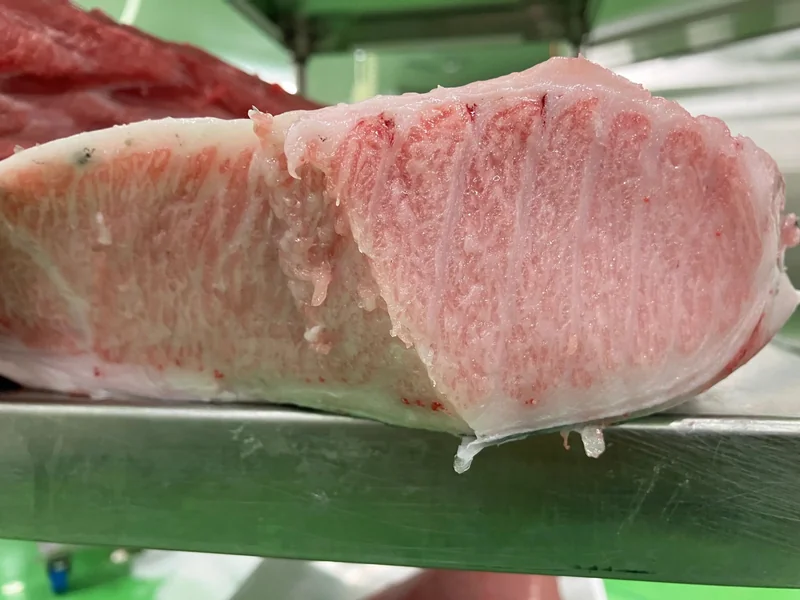
Jabara — "accordion" or "bellows" in Japanese — is the outermost edge of the Harakami belly, where the fat layers undulate in visible folds perpendicular to the muscle fiber. It is the most structurally distinctive part of the Otoro zone: the accordion fat architecture is unmistakable on the cut face, and the sinews running through are more pronounced here than in the inner belly.
This is not a flaw — it is the character of the cut. Jabara is intensely fatty and slightly fibrous, with the sinew providing structure that the pure-fat inner Otoro does not have. Moving inward from Jabara, the sinews fade and the texture becomes progressively finer and more marbled — the transition toward what we call marbling Otoro and, beyond that, Chutoro.
Inner Harakami · Otoro–Chutoro Gradation
Marbling Otoro — 霜降り
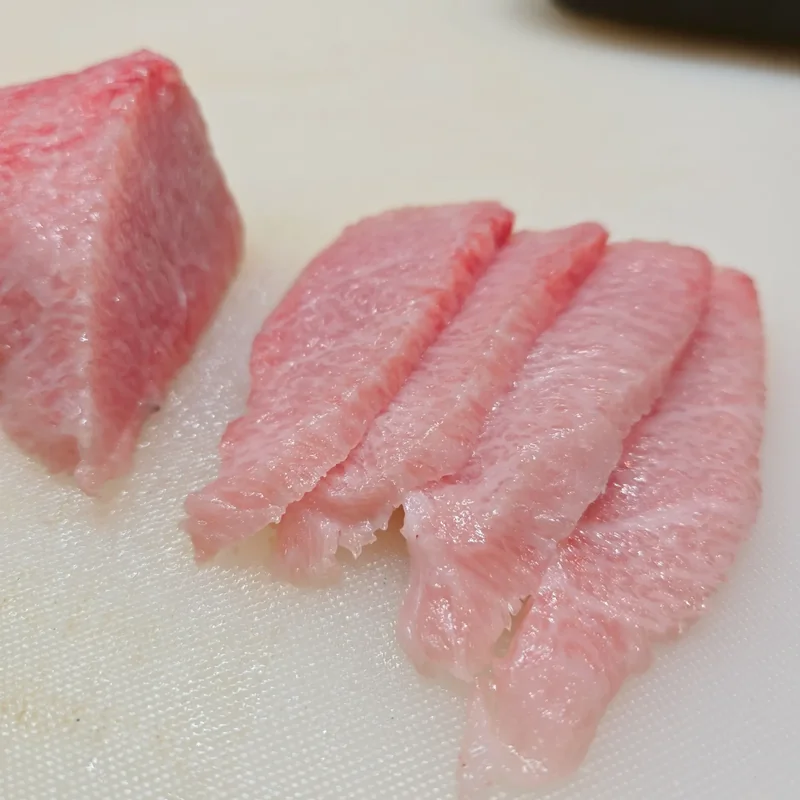
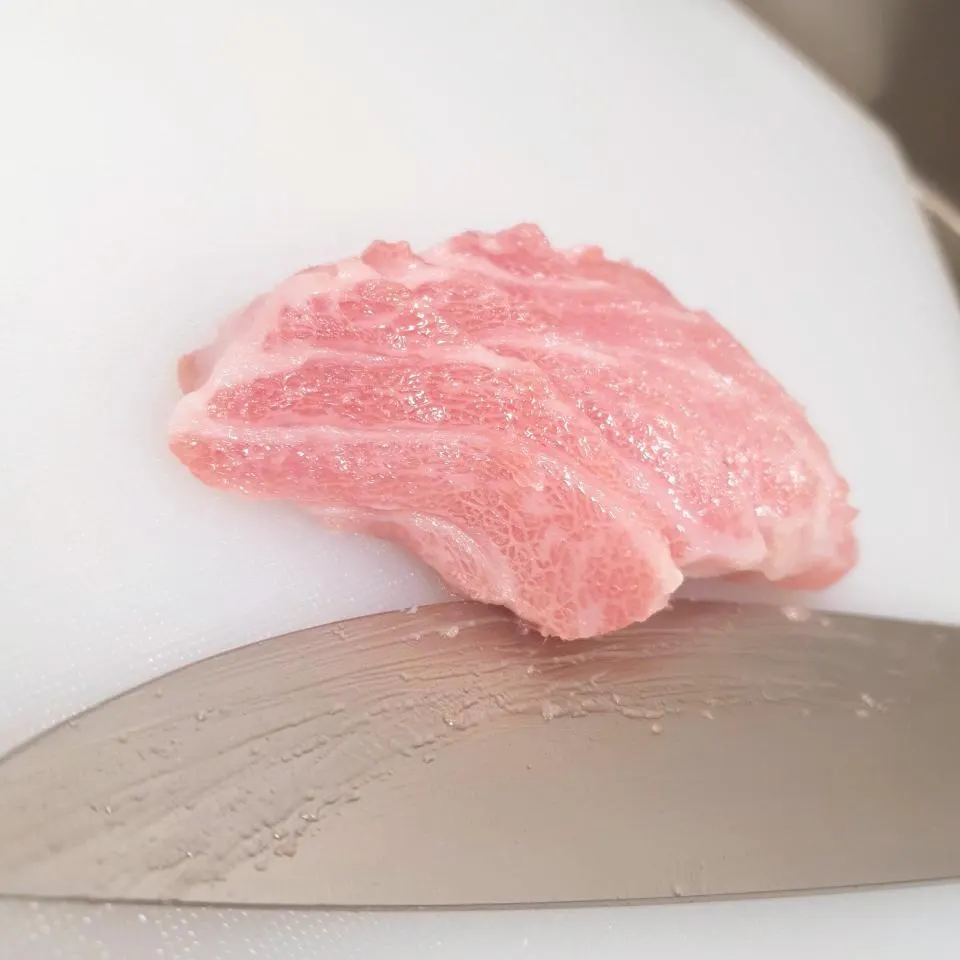
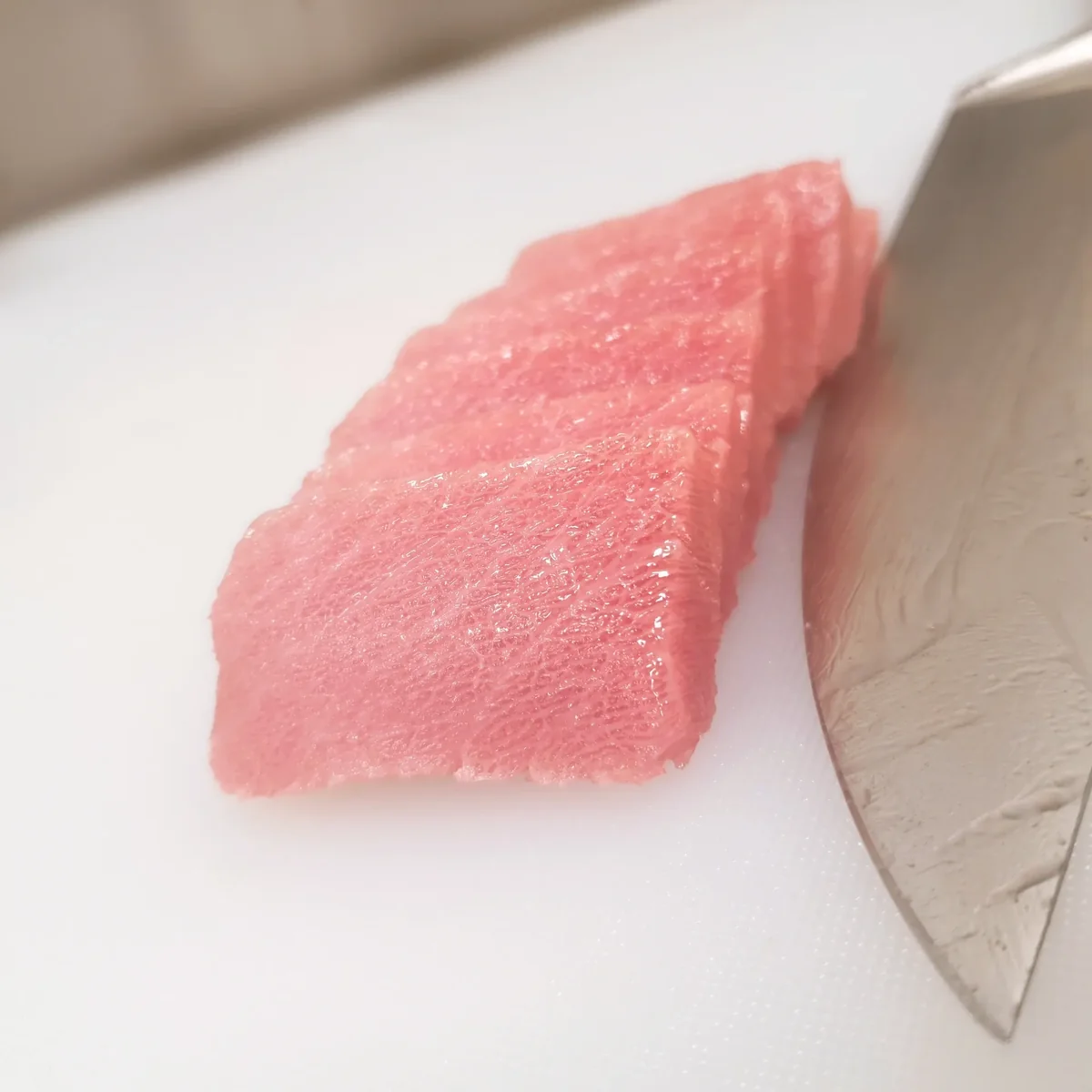
Moving inward from the Jabara edge of the Harakami belly block, the sinews fade and the fat distribution becomes progressively finer — evenly dispersed through the muscle in the intricate marbling pattern visible on the cut face. This is the section between Jabara and Chutoro, with no single established name in the industry. We call it marbling Otoro.
It is the most texturally refined part of the Otoro zone: the fat is present throughout but lacks Jabara's bold structure, yielding a melt that is smooth and uninterrupted. The lean muscle running through contributes umami that pure Jabara cannot — a balance that many find more complex than either extreme.
If you have a preference — Jabara's pronounced fat architecture versus the finer marbling of the inner belly — let us know at pickup and we will cut to your preference from the Harakami block.
Fat content — relative scale
Indicative of relative fat content within the Nagasaki Bluefin. Actual values vary by individual fish and season.
What is the difference between Otoro, Kamatoro, and Chutoro?
All three are fatty cuts from the same Goto Islands Bluefin — but they come from different parts of the fish and eat differently. Kamatoro is the collar; Otoro is the lower belly; Chutoro is the upper belly and back. Fat content, texture, and availability each differ.
| Kamatoro | Otoro | Chutoro | |
|---|---|---|---|
| Source | Collar (Kama) | Lower belly | Upper belly & back |
| Fat level | Highest on the fish | Very high | Medium — balanced |
| Texture | Silky, almost spreadable | Rich, melt-in-mouth | Clean, lighter richness |
| Quantity / fish | Extremely limited — 2 collars | Limited — varies by season | More available than Otoro |
| Best eaten | Sashimi or lightly seared | Sashimi, nigiri, or aburi | Sashimi or nigiri |
| At Sashimi DC | Coming soon (sold as Kama for grilling) | Weekly — $74 / ~8 oz | Weekly — $60 / ~8 oz · ~15 slices |
Kama sells out first. If you want it, order early Thursday or Friday after the weekly arrival announcement.
How to eat it
How to slice Jabara: Slice cold — from refrigerator temperature. As Otoro warms toward room temperature, the fat softens and becomes harder to cut cleanly. A thick cut (8–10mm) preserves the accordion structure. Eat immediately after slicing — let it come up to room temperature for 2–3 minutes on the plate before consuming.
Aburi — torching the surface
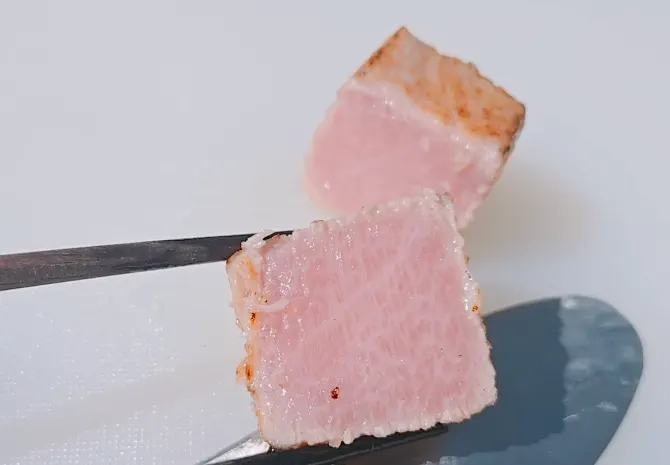
A brief pass of a kitchen torch over Otoro caramelizes the fat on the surface — the aroma is extraordinary and unlike anything you can produce from cooking alone. The exterior sears while the interior remains raw.
Works on any Otoro cut. Particularly striking on marbling Otoro and Kamatoro, where the fat content makes the caramelization most intense. Try it with a small amount of salt and a drop of Ponzu. Watch the recipe video →
Why Otoro is scarce — and why $74 is a different kind of price
Bluefin Tuna (本鮪) yields only 5–8% Otoro by body weight, depending on the season and the individual fish. That figure drops further when you factor in the sub-cuts — Kamatoro from the collar, Jabara from the ribcage, Harakami from the upper belly — each of which overlaps the Otoro zone but comes from a different location on the fish. Beyond Bluefin, Southern Bluefin (インドマグロ) yields some Otoro in its deepest belly, but far less. All other tuna species — Yellowfin, Bigeye, Albacore — do not produce meaningful Otoro at all. The cut is structurally rare.
A ~8 oz piece of Otoro yields approximately 15 slices of sashimi — enough for 3–4 people as part of a multi-fish spread, or 2 people making it the centerpiece. At a quality omakase counter in Washington DC, 15 pieces of Otoro nigiri would typically run $375–600 before tax and tip, depending on the restaurant. The same fish — same sourcing tier, same Ikejime processing, same never-frozen standard — is $74 here.
Otoro is also not the cut to eat every week. That is part of its logic. Akami and Chutoro are everyday luxury — the cuts you come back to Thursday after Thursday because they are that good and approachable. Otoro is the cut you bring out when something warrants it: a dinner party where you want one thing on the table no one has tasted before, a date night where the food should be the thing you talk about, or a quiet meal where you simply want the best version of the fish. Akami and Chutoro sell out by Saturday because they are the entry point. Otoro's availability deeper into the week is not a signal of lower demand — it is a reflection of how people use it.
If a guest at your table prefers a milder fish, Sasshu Salmon is a land-raised alternative from Kagoshima — its fat is clearly present in the marbling but does not overwhelm.
Fish arrives Wednesday. Best selection Thursday–Friday. Popular cuts can sell out by Saturday afternoon — order early in the week for Kamatoro and Jabara specifically.
Certified by Japan’s MAFF
Sashimi DC is certified as a Japanese Food and Ingredient Supporter Store by Japan's Ministry of Agriculture, Forestry and Fisheries (MAFF), administered by JETRO (Certification ID: J000-001-410, valid through May 2028). One of three certified establishments in Washington DC, including Sushi Taro and DC Sake Co (see the embassy’s list of certified businesses), and the only certified fish retail counter in the city.
Same-Day Sashimi Delivery to Maryland and Virginia
Same-day delivery runs 1–8 pm daily. Place your order by 7:30 pm for same-day delivery. Insulated packaging with ice pack and TTI temperature indicator included. $30 minimum.
- Arlington
- McLean
- Bethesda
- Vienna
- Fairfax
- Alexandria
- Falls Church
- Rockville
- Silver Spring
- Great Falls
- Reston
- Springfield
- Annandale
- Potomac
Coverage confirmed for all addresses above. Enter your address at checkout to verify. Also available for pickup daily at 1608 14th St NW, Washington DC.