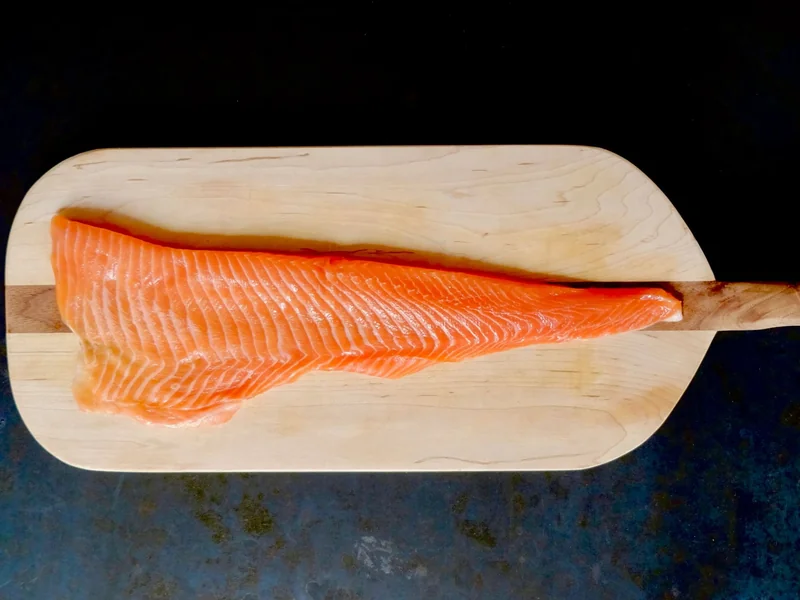
What is Sasshu Salmon?
Sasshu Salmon (薩州サーモン) takes its name from Sasshu — the old poetic name for Satsuma Province, the historical region of what is now Kagoshima Prefecture on Japan's southernmost main island. It is produced by Satsuma Sendai Unagi — a company whose name itself tells the story: they are eel farmers who applied decades of precision aquaculture expertise to salmon, creating something unlike anything produced through conventional salmon farming.
The result is widely regarded as one of the most refined farmed salmons in the world — not because of fat content alone, but because of the precision of its flavor profile. Where commodity farmed salmon tends toward a heavy, almost one-note richness, Sasshu Salmon has a cleaner, more layered character: bright, focused umami with no off-notes, and fat that is clearly present in the marbling but does not overwhelm.
US exclusive: Sashimi DC is the only place outside Japan where Sasshu Salmon is available. If you have seen it on a menu or at a counter in Washington DC, it came from here.
Three things that make it different
Flow-through groundwater (かけ流し養殖). The farm uses a continuous flow-through system fed by mineral-rich Kagoshima groundwater. Unlike recirculating systems where water is filtered and reused, the water here flows constantly through the tanks — always fresh, oxygen-rich, and at the precise temperature of the natural groundwater. Water quality at intake meets drinking standards. Oxygen levels and temperature are monitored by IoT sensors 24 hours a day.
Chiran tea in the feed (知覧茶). The feed incorporates Chiran tea — a high-grade green tea from Chiran, Kagoshima, which holds the distinction of Japan's highest green tea production volume. The polyphenols in the tea suppress the development of off-flavors in the fat, producing what the farmer describes as "clear umami without any off-notes" (雑味のないクリアな旨み). This is not a marketing story. It is a direct explanation for why Sasshu Salmon tastes the way it does — clean, defined, with none of the fishiness that characterizes poorly handled or poorly reared salmon.
24/7 precision monitoring. Water temperature, oxygen levels, and tank conditions are monitored continuously — 24 hours a day, 365 days a year. The same thoroughness that eel farming demands was applied here. The result is a consistent product that tastes the same week to week, because the growing environment never drifts.
Each Sasshu Salmon cut (~9 oz) yields approximately 18 slices of sashimi — enough for 3–4 people as part of a shared meal or 2 people as a standalone course.
Why it can be served fresh — and never frozen
Most salmon served raw in the United States must be frozen before service to eliminate parasites — a legal requirement under FDA HACCP guidelines for wild-caught fish. Sasshu Salmon is different. Under FDA HACCP guidance (21 CFR 123, Chapter 5) and DC's food code (25-A DCMR § 903.2(c)), fish raised only on formulated feed in a closed aquaculture system are exempt from the freezing requirement that applies to wild salmon — see our guide to parasite safety in raw fish for the full regulatory detail. Parasite risk is negligible, not zero.
Because it is raised exclusively on a controlled formulated diet in a managed aquaculture environment, it has no access to infected wild prey. Under FDA HACCP regulations, fish raised on formulated feed without exposure to infected wild organisms do not carry a parasite hazard and can be served fresh, without freezing. The result is salmon that arrives in Washington DC at peak quality — the fat intact, the color natural, the texture exactly as it was when it left Kagoshima.
No freezing means no ice-crystal damage to the cell walls. The texture of properly fresh Sasshu Salmon is noticeably firmer and cleaner than frozen-then-thawed alternatives — including products marketed as "fresh" that were frozen at some point in the supply chain.
Keeping the fish fresh also preserves what matters nutritionally. Fish oils — EPA and DHA, the omega-3 fatty acids that support cardiovascular and brain health — continue oxidizing in a standard freezer, building off-flavors and degrading over time. Sasshu Salmon arrives with its omega-3 content intact, exactly as it was when it left Kagoshima. What freezing does to fish →
How it compares
| Attribute | Sasshu Salmon | Typical farmed Atlantic | Norwegian / commodity |
|---|---|---|---|
| Origin | Kagoshima, Japan | Various | Norway / Chile |
| Frozen | Never | Often | Often |
| CO treatment | Never | Possible | Possible |
| Parasite risk | Negligible (formulated feed, closed tanks) | Varies by source | Varies |
| Flavor character | Clean, layered, restrained richness | Variable | Often heavy, oily |
| Fat distribution | Precise marbling | Variable | Often uneven |
| US availability | Sashimi DC only | Widely available | Widely available |
Most salmon sold in the US is raised in open ocean net pens or recirculating systems. Sasshu Salmon is raised in land-based, flow-through tanks, so the comparison above is as much about production system as about taste. For the full science of wild versus farmed — flavor chemistry, sustainability, and parasite data — see wild vs. farmed fish.
How to eat it
Sasshu Salmon is excellent as straightforward sashimi — sliced at a moderate angle (sogi-zukuri, around 30–40° from vertical) to produce a larger surface area that shows the marbling clearly. The natural flavor needs no accompaniment beyond a small amount of tamari and fresh wasabi.
It also makes outstanding Temaki (hand rolls) and is one of the most approachable fish for first-time home sushi — the flavor is generous and clearly delicious without requiring the nuanced palate that Bluefin Tuna rewards. For the slicing technique and Temaki assembly, see the home sushi guide.
For a first-time order, Sasshu Salmon paired with Chutoro — a well-balanced cut of our ikejime Bluefin Tuna with both umami and fat — gives a useful comparison between the two flavor profiles: the clean brightness of the salmon against the rich umami and fat of the tuna.
Certified by Japan’s MAFF
Sashimi DC is certified as a Japanese Food and Ingredient Supporter Store by Japan's Ministry of Agriculture, Forestry and Fisheries (MAFF), administered by JETRO (Certification ID: J000-001-410, valid through May 2028). One of three certified establishments in Washington DC, including Sushi Taro and DC Sake Co (see the embassy’s list of certified businesses), and the only certified fish retail counter in the city.