The Access Problem
Upscale sushi isn't
designed for kids.
Washington DC has excellent sushi restaurants. Most of them are quiet, counter-seated, and expect a certain pace. None of that is a criticism — it's the nature of the format. But it does mean that for many families, getting children in front of genuinely sashimi-grade fish isn't straightforward. Kid-friendly Japanese restaurants typically don't carry the same quality. The gap between "something a child will sit through" and "actually great fish" is wider than it needs to be.
Sashimi DC exists partly to close that gap. The fish Sashimi DC sources is the same caliber as the finest omakase counters in Tokyo — direct import, Ikejime-processed, never frozen, never CO-treated, fully traceable. The difference is that it comes to your kitchen, not a restaurant counter. Your pace, your volume, whatever side dishes make the evening work for a family. Same-day delivery daily from 1:00 pm – 8:00 pm, or pickup at 1608 14th St NW from 11:30 am.
Good starting point for first-timers: Kagoshima Sasshu Salmon and Bluefin Tuna Akami are both mild-enough entries for children new to raw fish. Otoro and Uni are better introduced once there's a foundation.
Clean Fish Needs No Cover
Fish that speaks
for itself.
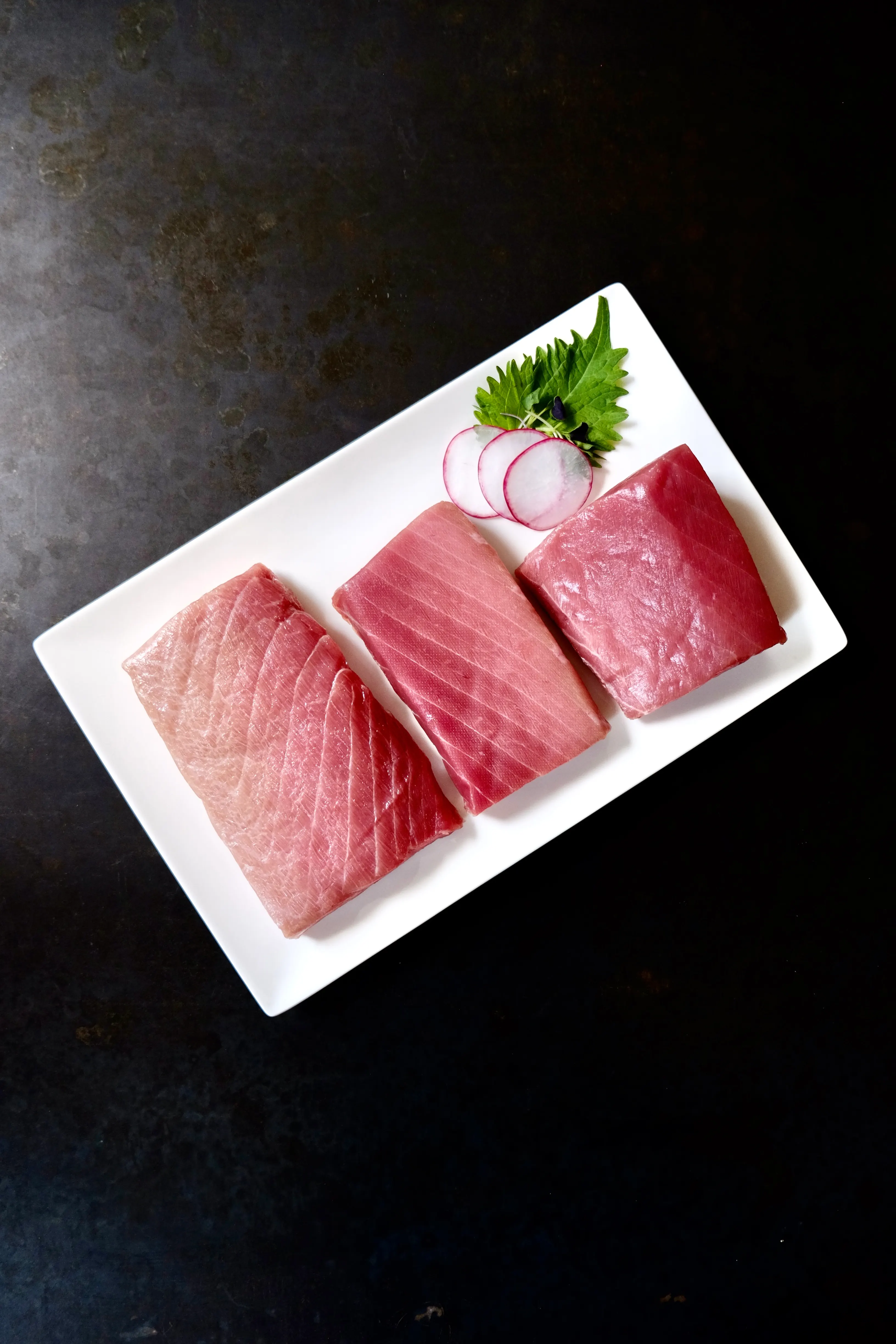
Does your child say they don't like fish? It might not be the fish — it might be the fish they've been eating. Kids don't filter their reactions. If something smells off or tastes stale, they'll say so. That honesty is actually useful: try them on a piece of genuinely fresh, properly handled sashimi-grade salmon or tuna, and see what they say. You might be surprised.
There's a reason low-quality fish comes buried in sauces, tempura flakes, and spicy mayonnaise: it needs the help. Fish that is genuinely fresh and properly handled carries its own flavor cleanly — it doesn't need to be masked. That also means it arrives at children without a payload of additives.
Sashimi DC's fish is never frozen (with the exception of certain preparations required by FDA regulations for specific species), never treated with carbon monoxide, and processed by the Ikejime method in Japan. Ikejime — immediate neural immobilization at harvest — prevents lactic acid buildup and preserves both flavor and texture. CO-treated tuna is dyed a vivid cherry-red that holds for weeks; our Akami is naturally dark red-purple, which is the correct color of fresh, untreated bluefin. What you see is what the fish actually is.
The result: fish that tastes like itself. Suitable for children who haven't yet developed a taste for condiments, and for parents who'd rather not navigate an ingredient list.
Nutrition
Why fish is genuinely
good for kids.
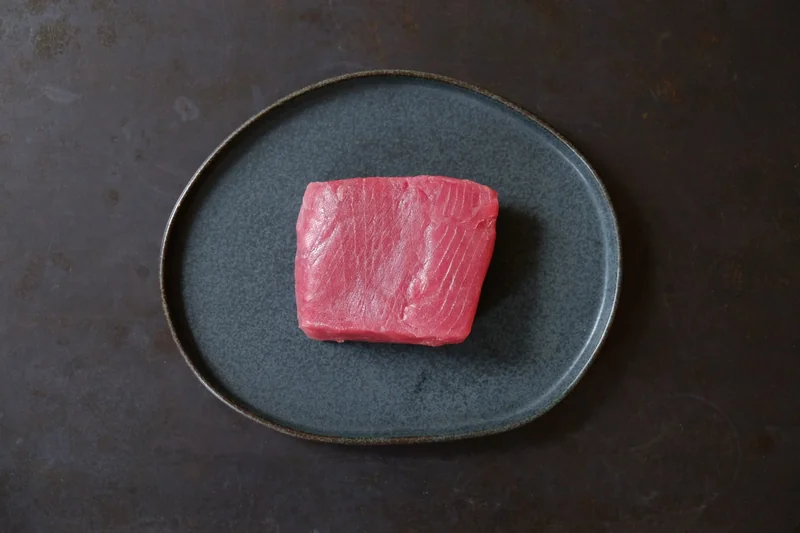
Fish is among the most nutrient-dense foods available. For children specifically, several nutrients in high-quality fish are particularly relevant:
| Nutrient | Why it matters for children | Notable source at Sashimi DC |
|---|---|---|
| DHA / EPA (Omega-3) | DHA is the primary structural fat in the brain and retina. Adequate DHA during development is associated with cognitive function and visual acuity. EPA supports cardiovascular health. Goto Islands Bluefin Tuna delivers 2.18g DHA + 0.693g EPA per 100g serving — fattier cuts like Otoro and Chutoro carry proportionally more per gram due to marbling. | Bluefin Tuna (especially Otoro and Chutoro), Sasshu Salmon |
| Iron (heme iron) | Heme iron from fish and meat is absorbed at roughly 2–3× the rate of non-heme iron from plant sources. Iron deficiency is common in children and affects energy and cognitive development. | Bluefin Tuna Akami — one of the highest-iron fish available |
| High-quality protein | Complete protein with all essential amino acids, in a highly bioavailable form. Supports growth and muscle development without the saturated fat load of many other protein sources. | All fish at Sashimi DC |
| Vitamin D | Critical for calcium absorption and bone development. Many children in temperate climates are deficient. Fatty fish is one of the few significant dietary sources. | Sasshu Salmon, Bluefin Tuna |
| Vitamin B12 | Essential for nervous system development and red blood cell formation. Found almost exclusively in animal products. | Bluefin Tuna, Sasshu Salmon |
A note on mercury: Sashimi DC's Bluefin Tuna is aquacultured (farm-raised) in the Goto Islands, Nagasaki, harvested at 2–3 years. Because mercury bioaccumulates over a fish's lifetime, farmed Bluefin — reaching harvest size far faster than wild-caught Bluefin (10–20+ years) — carries measurably less mercury. Published data on Japanese farmed Pacific Bluefin shows a median Hg of ~0.40 mg/kg in biopsied muscle (Takagi et al., 2025), less than half the FDA action level of 1.0 µg/g. Wild adult Bluefin can exceed that limit. Mercury is not zero, and standard portion guidance applies. The FDA and EPA recommend children eat 1–2 servings of fish per week; farmed Goto Bluefin fits well within that guidance. Full guide: Mercury in Tuna → · Full nutrition breakdown → · Complete safety guide →
Family Activity
Making sushi together
is the meal.

Temaki (hand rolls) are the natural format for a family fish night. They require no special equipment, no precise knife skills, and children from age 5 or 6 can participate meaningfully — laying rice on Nori, choosing their fish, rolling the cone. The involvement raises the stakes in the best way: kids are more likely to eat what they helped make.
The Sashimi DC Home Sushi Kit ($50) includes everything except the fish: premium Japanese short-grain rice, Sushizu (seasoned rice vinegar), soy sauce, Nori, and wasabi. Also available separately: fresh wasabi rhizome ($15/oz). Order a piece or two of salmon or tuna alongside it and you have a complete family dinner. The step-by-step home sushi guide covers rice preparation, slicing technique, and Temaki assembly in full.
Sashimi DC delivers same-day to Bethesda, Rockville, Potomac, Silver Spring, Arlington, McLean, and across the DC metro — order fish and the Home Sushi Kit together for a complete family dinner with no grocery run needed.
Sashimi DC also hosts occasional hands-on sushi making classes at Rice Market DC — check the events page for upcoming dates.
Community
Supporting the next
generation.

Sashimi DC is part of the DC Japanese and Japanese-American community, not just a vendor to it. Keita Miyaki actively participates in fundraisers for organizations that serve children and families in the region:
Washington Japanese Language School
A Washington DC institution supporting Japanese language education for children in the DC metro area.
Washington Japanese Heritage Center
Preserving and sharing Japanese culture and history with the broader DC community, including next-generation Japanese-Americans.
Fox Mill Elementary School — Japanese Immersion Program
A public school immersion program in Fairfax County giving children the chance to grow up bilingual in Japanese and English.
We're grateful to be able to contribute to the next generation of this community, and we see families as the center of what we're building — not an afterthought.
Food Safety
Is sashimi-grade fish safe
for children to eat raw?
The short answer is yes — with the right fish from the right source. The longer answer is that "sashimi-grade" is not a regulated term in the United States, which means the label alone tells you nothing. The distinction that matters is how the fish was actually handled.
Fish sold as "sushi-grade" at a standard supermarket may have been previously frozen, held for several days, or treated with additives to extend shelf life. Sashimi DC's fish arrives in approximately 48 hours from Japan, processed by the Ikejime method, never CO-treated, never frozen, and fully traceable. That handling timeline and process is what makes it appropriate for raw consumption — not the label.
Best starting points for children: Sasshu Salmon (Kagoshima) and Bluefin Tuna Akami are the two most approachable options. Both are mild in flavor, clean-tasting, and free of the strong fishy odor that often puts children off — that odor is a sign of age or poor handling, not something inherent to raw fish. For children who are hesitant about raw fish altogether, Unagi Kabayaki (pre-cooked eel, from Kagoshima) is a fully cooked, crowd-pleasing alternative that requires no raw preparation and works well alongside the Home Sushi Kit.
Cold-chain guarantee: Every delivery order includes an insulated bag, 1 lb+ ice pack, and a TTI (Time-Temperature Indicator). If the TTI shows the package was exposed to temperature abuse in transit, Sashimi DC provides a full refund — no questions asked. This applies to all delivery orders across DC, MD, and VA.