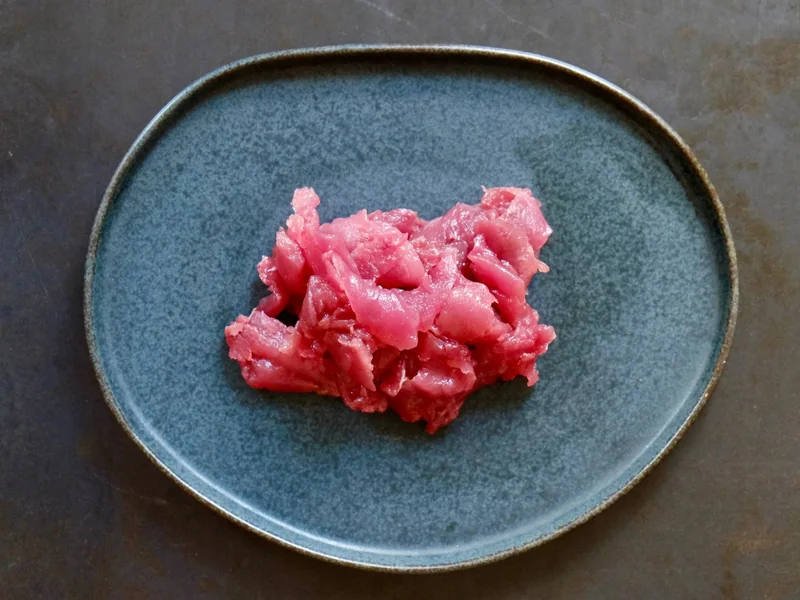
Can I buy Nakaochi (rib-scraped Bluefin Tuna) in Washington DC?
Yes — Sashimi DC carries Nakaochi from Goto Islands, Nagasaki — rib-scraped Bluefin Tuna meat, the classic base for Negitoro. Ikejime-processed, never frozen, flown direct from Japan. Available in-store at 1608 14th St NW, DC (inside Rice Market) and same-day delivery across DC, Virginia, and Maryland.
What is Nakaochi?
Nakaochi (中落ち) is the meat that clings to and between the rib bones of the Bluefin — retrieved by hand-scraping after the main saku blocks have been removed. The process is labor-intensive and the yield small.
The texture is softer than any saku cut, almost spreadable, with a natural sweetness and concentrated richness that reflects its proximity to the fat-rich belly cavity. In Japan, Nakaochi is the traditional filling for Negitoro (ネギトロ) — mixed with finely sliced scallion and served on rice or rolled in Nori. The fish carries enough flavor that nothing else is needed.
Negitoro at home: Roughly chop the Nakaochi with a knife — do not blend — combine with finely sliced scallion. Serve on warm Shari, wrap in Nori, or eat directly. The flavor of the fish is concentrated enough that it needs nothing else — no sesame oil, no additional seasoning.
Nakaochi ships vacuum-sealed, so it stays protected from oxygen until you open the package. Because it's hand-scraped rather than cut from an intact saku block, it has more exposed surface area once opened than a sliced cut — for best texture and flavor, plan to use it the same day you open the package rather than holding it like Akami or Otoro. See the FAQ below for full storage guidance.
How to eat it
Negitoro: The classic. Chop with scallion, serve on rice. See the recipes page for video guidance. Gunkan Maki: Wrapped in Nori around a ball of Shari. On its own: A small spoonful with a drop of tamari. If you prefer a milder fish, Sasshu Salmon from Kagoshima is a land-raised alternative — never frozen, with a clean, restrained flavor.
Where this fish comes from
Every piece of Bluefin Tuna at Sashimi DC comes from Hosei Suisan (宝生水産), a farm in the Kamishima Wakamatsu area of the Goto Islands, Nagasaki Prefecture — the westernmost islands of Kyushu, where the Pacific and East China Sea converge.
The Goto Islands maintain water temperatures that never fall below 13°C in winter and rarely exceed 29°C in summer — the stable, narrow range that Bluefin Tuna require for consistent growth and quality. Hosei Suisan operates in the Kamishima Wakamatsu area, one of the most environmentally favored zones for marine aquaculture within the islands.
Hosei Suisan uses wild-caught seed stock (天然種苗) rather than hatchery-bred fish. Feed is sourced fresh and locally, centered on fresh mackerel (生サバ) bought directly by their own trucks from local fishermen. Director Tsuneya Yamashita explains the choice: mackerel produces better fat marbling and color than sardines. As mackerel catches have declined and prices risen in recent years, they secured dedicated year-round supply agreements with their fishing partners to maintain the standard. Post-harvest handling — the initial processing and preparation after the fish is landed — is also a focus: Ikejime is performed in Nagasaki, at source.
Two-time award winner: Hosei Suisan won the top prize (最優秀) at the Nagasaki Prefecture Farmed Bluefin Tuna competition twice — once in December 2014, and again on December 8, 2023 — showcasing the fish from Japan’s leading farmed Bluefin production prefecture.
After Ikejime processing in Nagasaki, the fish is transported to a specialist Miyazaki processor where it is broken down into saku blocks, then flown Fukuoka → Haneda → IAD.
Sashimi DC is a MAFF-certified Japanese Food and Ingredient Supporter Store (ID J000-001-410) — the only certified fish retail counter in Washington DC. See the embassy’s list of certified businesses.