September has been a rough month for Japan's weather and its fish markets alike. Tokyo saw nine straight days of rain from the 4th through the 12th, the rain came back yesterday, and Typhoon No. 25 is forecast to hit early next week. Less fishing activity means less fish reaching auction — prices are up and volume is down broadly right now.
This Week's Delivery Splits Across Two Days
Because of the logistics disruption, our shipment is arriving in two parts. Hokkaido Uni, Hokkaido Scallops, fresh wasabi, and shiso leaves are in today (Wednesday) as usual. Bluefin Tuna and Sasshu Salmon are arriving Friday instead of their usual day.
This Week's Star: Date-Maguro from Ehime
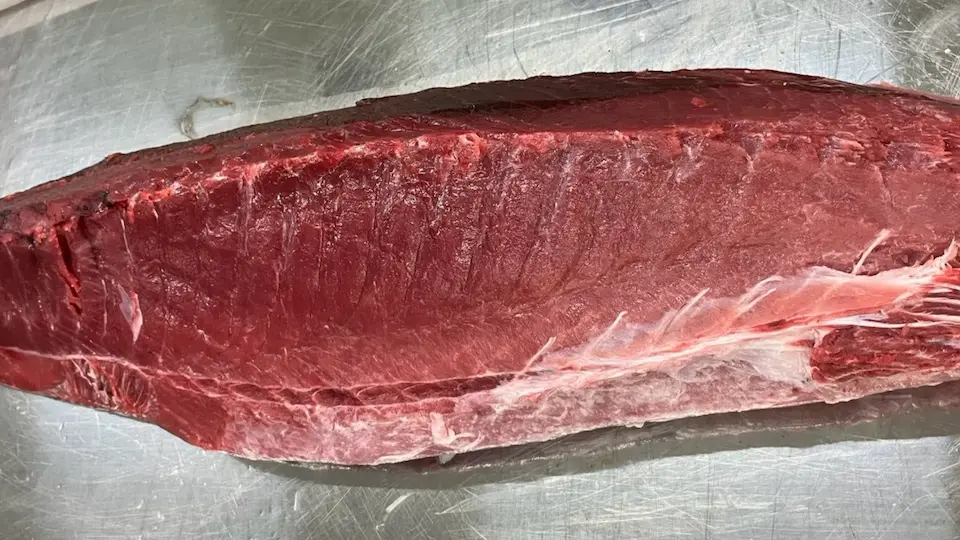
Friday's Bluefin Tuna is something new for us: "Date-Maguro" (だてまぐろ) from Tsuji Suisan, farmed in the Uwakai Sea off Hiburi Island and Ainan-cho, Ehime Prefecture. The water there holds a steady 16–27°C year-round — ideal for raising bluefin — and Tsuji Suisan takes up to six years to bring a fish to size, without cutting corners on time or care. Only fish farmed for 30 months or more and weighing 45kg or above earn the Date-Maguro name.
The extra time shows in the eating: fine, clean marbling, the classic rich bluefin aroma, and a texture that melts rather than simply softens — producers describe it as tasting close to a wild-caught fish, not the fast-grown farmed tuna most people picture. The farm holds both HACCP certification and an AEL (Aquaculture Eco-Label) certification.
Handled Like a Fresh Catch, Not a Commodity
Freshness is treated with the same discipline as wild-caught fish: each tuna is harvested to order, bled within about two minutes, given shinkei-jime (spinal nerve destruction) to halt stress responses, and has its viscera and gills removed immediately — then chilled in shio-gori (brine ice) to lock in quality. On the safety side, the farm runs regular quality and export inspections, keeps radioactivity testing results for feed on file, and maintains full production records so every fish is traceable back to source.
A Fishing Ground with a Long History
The Uwakai Sea sits off the southwest coast of Shikoku, fed by the nutrient-rich Kuroshio Current. Its rias coastline — a jagged shoreline of narrow inlets — has supported aquaculture in this region for generations, and the combination of water temperature, depth, and current makes it especially well-suited to raising bluefin tuna.
Everything Else This Week
Alongside Wednesday's Hokkaido Uni, Hokkaido Scallops, fresh wasabi, and shiso leaves, Friday brings Bluefin Tuna (Date-Maguro) and Sasshu Salmon back into the case.
Shout-Out: Sake District's Fall Lineup
Sake District has a full slate over the next few weeks. Gastronomy: Tea, Sake, Food runs September 27 from 12:30–6pm — a ticketed four-course lunch tasting from 12:30–2pm, followed by a walk-in tea and sake lounge from 2–6pm. The Koji Table, a 5-course fermentation dinner from Michelin-starred chef Brad DeBoy with sake pairings by Scott Movens, follows September 28 from 7–9:30pm. On October 2, Sake District takes over Black Crown Collective for a walk-in-only guest shift (2–7pm) featuring hot sake service and rare aged pours from Scott's personal collection. And on October 3 from 1–3pm, cheese expert Alice Bergen Phillips and Scott Movens lead a Sake and Cheese Pairing Class at Ama. See their events page for details on each.