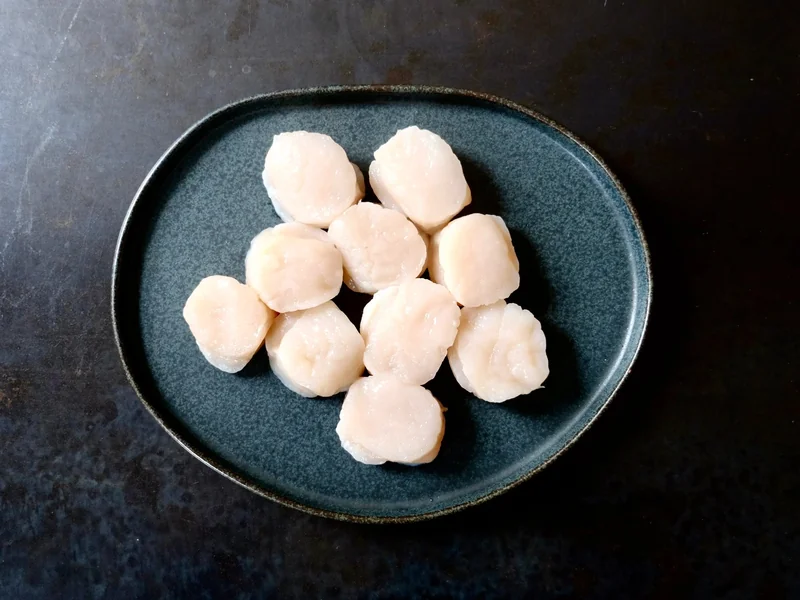
Where can I buy dry Hokkaido scallops in Washington DC?
Sashimi DC at Rice Market (1608 14th St NW) sells Hokkaido hotate scallops — untreated, with no phosphate (STPP) — for $34.50 per ~5 oz adductor muscle. Dry scallops like these sear cleanly instead of steaming. Pickup daily 11:30 am–8 pm, or same-day delivery across the DC area.
What most people don't know about scallops in the US
In the United States, the majority of scallops sold at retail and in restaurants have been treated with sodium tripolyphosphate (STPP) — a food additive that causes the adductor muscle to absorb water. The result is a scallop that weighs noticeably more, appears plump, and commands a better price per pound. These are called "wet scallops."
The problem is what happens when you cook them. The absorbed water turns to steam in the pan. Because free water at the surface can't exceed 100°C until it fully evaporates, the pan temperature drops and the Maillard reaction — which requires around 150°C at the surface — can't begin. Instead of a golden sear, you get steaming and shrinkage, sometimes dramatic. A scallop that looked substantial raw can shrink to half its apparent size. The flavor, too, is diluted by the absorbed water.
This practice is common enough that the minority without treatment has its own name: "dry scallops." In Japan's domestic market, the question doesn't arise: scallops retailed in Japan are not soaked. The soaked, China-processed scallops are made for the US and other export markets. Sashimi DC's Hokkaido scallops are different: we import dry scallops directly from Hokkaido and never import wet scallops, so the scallop you receive is the scallop that was harvested. Not every Japan-origin scallop sold in the US is dry — some are shelled and soaked in third countries and still labeled "Product of Japan" (JETRO, 2024).
Why phosphate treatment exists in the US supply chain: Sea scallop shells don't close tightly once removed from water, so the meat actually loses moisture quickly and spoils fast after harvest. US scallop boats often stay out at sea a week or more, so STPP is applied at sea or shortly after harvest specifically to preserve the scallops through that long transit — the water-and-STPP solution extends shelf life and, as a side effect, adds extra water weight. Japanese scallops move through a much shorter chain — landed, processed, and shipped quickly — so there's less need for a shelf-life-extending treatment, and buyers of raw-grade scallops, such as sushi restaurants, want them untreated (JETRO, 2024).
Hokkaido — Japan's scallop heartland
Hokkaido accounts for the vast majority of Japan's scallop production. The prefecture sits at the convergence of the Oyashio Current — cold, nutrient-dense water flowing south from the Arctic — and the warmer Tsugaru Current. The resulting plankton density is exceptional. Hokkaido's wide coastal seas (the Okhotsk Sea, Funka Bay, the Nemuro Strait) each offer distinct conditions, and scallops grown in each location have different characters.
Two farming methods dominate Hokkaido:
Jimaki (底撒き) — bottom seeding
Juvenile scallops raised in hatcheries are released onto the seafloor after one year, then left for 2–4 years to grow freely in the natural environment. Used in the Okhotsk Sea and around the Nemuro Strait. Because the scallops move constantly in ocean currents — opening and closing their shells to swim — they develop muscular, firm adductor muscles. The flavor is clean and sweet. Okhotsk jimaki scallops are among the best in Japan for raw consumption: sashimi, sushi, carpaccio.
Suika (垂下) — longline suspension
Juveniles are placed in net bags or hung on ropes in the water column and grown for 1–2 years. Used in Funka Bay and on Hokkaido's Japan Sea coast. The scallops move much less, so instead of building muscle they accumulate energy reserves — which express as richer, more concentrated umami. The adductor is softer and more intensely flavored. Suika scallops respond particularly well to heat: butter-seared, grilled, or used in hot preparations where the concentrated sweetness can develop further.
| Jimaki (底撒き) | Suika (垂下) | |
|---|---|---|
| Farming | Seabed, free-growing, 2–4 years | Suspended ropes/cages, 1–2 years |
| Region | Okhotsk Sea, Nemuro Strait | Funka Bay, Japan Sea coast |
| Peak season | Summer (May–September) | Winter (December–March) |
| Texture | Firm, springy, muscular | Softer, tender |
| Flavor | Clean sweetness, oceanic | Rich, concentrated umami |
| Best for | Raw: sashimi, sushi, carpaccio | Cooked: butter-seared, grilled, nabe |
What do Hokkaido scallops taste like?
Raw Okhotsk jimaki hotate tastes clean and sweet with a springy bite and a faint oceanic finish. Winter suika hotate is softer and richer, with more concentrated umami that deepens when seared. Both are noticeably sweeter than a phosphate-treated scallop, whose flavor is diluted by added water.
Two peak seasons — why scallops have a rhythm
Hokkaido scallops are said to have two seasons of peak flavor (旬が2度ある). This is not marketing — it reflects the biology of the animal and the ecology of the regions where it's raised.
Summer peak: May – September (Okhotsk / Soya)
In late spring, scallops coming up to spawning season have built up their adductor muscles and reached maximum body weight. Once they spawn in April, condition temporarily dips — but recovery is rapid. By May, Okhotsk scallops are again accumulating energy from the plankton-rich water brought by receding sea ice. Through July and into September, the Soya Strait scallops — shaped by the strong currents where the Japan Sea meets the Okhotsk — reach their most muscular, springy state. This is the season for eating hotate raw: thick-cut sashimi with wasabi and soy, or lightly torched for aburi nigiri.
Winter peak: December – March (Funka Bay / Notsuke)
As water temperatures drop through autumn, Funka Bay scallops shift from growth mode to storage mode — accumulating glycogen and amino acids (the compounds responsible for umami and sweetness) as cold-weather reserves. By December the adductor muscle is dense with these compounds. It doesn't shrink much under heat. It takes a butter sear and gives back concentrated sweetness. This is the season for cooked hotate: butter-yaki, hotpot, gratin, or simply grilled in the shell over charcoal.
Spawning season (April): not a good time
Around April, scallops spawn. During and immediately after spawning, the adductor muscle is depleted — the scallop is physically weak, has less flavor, and its condition (the ratio of meat to shell) is at its lowest. Cold chain integrity matters more at this time because the weakened tissue is less tolerant of temperature variation. We do not carry scallops during the spawning period for this reason.
How to eat Hokkaido hotate
Raw
Summer Okhotsk scallops at their peak are outstanding raw. Slice the adductor thickly — about 1 cm — and serve chilled with wasabi and soy sauce. The sweetness is immediate; the oceanic finish lingers. For a lighter approach, ponzu (citrus soy) works well and doesn't mask the natural flavor. Carpaccio with a drizzle of yuzu olive oil and a few flakes of sea salt is another excellent option.
Eat raw scallops the day you collect them and keep them cold until slicing. Our scallops arrive from Hokkaido on the Wednesday shipment, so Thursday and Friday orders are the freshest. For how we judge a fish safe to eat raw, see our guide to sashimi-grade fish.
Seared
Dry scallops sear correctly because they contain no absorbed water to steam off. Pat dry with a paper towel, season lightly with salt, and sear in a very hot pan with neutral oil — 90 seconds per side maximum for a scallop of this size. The result should be a deep golden crust with a just-translucent center. Butter and thyme at the end. Do not overcook; the interior should remain soft.
Because these scallops have not been phosphate-treated, they will not shrink dramatically when seared. What you buy is what you cook. It will shrink far less than a phosphate-treated scallop, since there is no added water to cook out.
Grilled in the shell (if shells available)
The traditional Japanese preparation: scallop in the half-shell over charcoal or a gas burner, topped with a small amount of butter, a splash of soy sauce, and a sliver of mirin. The shell becomes a cooking vessel; the liquid that collects and reduces in the shell concentrates the flavor. Simple, dramatic, difficult to improve on.
Butter-yaki
Pan-sear in butter over medium-high heat until golden. Add a small splash of soy sauce and mirin to the pan in the last 30 seconds to glaze. The sugar in the mirin caramelizes slightly; the soy adds depth. A preparation that works for both summer and winter scallops.
Sashimi with uni
A natural pairing: thick-cut hotate sashimi with a small amount of Hokkaido uni placed on top. Both are from the same cold northern waters; the sweetness of the scallop and the briny richness of the uni reinforce each other. No additional sauce needed — the combination speaks for itself.
How to read a scallop label
Most scallops at US retail carry no treatment disclosure beyond the ingredient list — and most consumers don't read ingredient lists on seafood. A few labels worth knowing:
- "Dry scallops" — untreated, no STPP. The weight you see is the weight you get.
- "Wet scallops" — treated with sodium tripolyphosphate. Expect shrinkage and steaming in the pan rather than browning.
- "All natural" — may indicate untreated, but it is not a guarantee. Check for "dry" or "no STPP" on the label or in the ingredient list.
- "Product of Japan" — follows the animal, not where it was processed. Under a 2022 CBP ruling (N326448), shucking, washing, or freezing in a third country does not change country of origin. A scallop harvested in Hokkaido and shelled in China is still "Product of Japan" at a US retail counter.
Japan-origin does not guarantee untreated. Some Japanese scallops are shipped in the shell to China, shucked, soaked in a phosphate solution and re-frozen before reaching US stores — and US customs treats that processing as minor, so the label still says "Product of Japan" (JETRO, 2024; CBP ruling N326448, 2022). Some dry frozen scallops are also soaked after import for the cooking market. Sashimi DC's Hokkaido scallops are different: we import dry scallops directly from Hokkaido and never import wet scallops. If a label doesn't say "dry," ask.
If the label just says "fresh scallops" with no treatment disclosure, it's reasonable to ask. If the answer is unclear, assume wet.
Hokkaido scallops from Sashimi DC are untreated. There is nothing to ask about — no STPP, no phosphate, no added moisture. What you buy is pure adductor muscle.
Sizing grades — what the numbers mean
US scallop grading uses a count-per-pound system. U10 means fewer than 10 scallops make up one pound — these are large scallops. U20/30 means 20–30 per pound — significantly smaller. The "U" stands for "under."
Japanese grading runs in the opposite direction, by count per kilogram. The premium end is JJ (10 or fewer per kilogram) and J (11–15 per kilogram) — very large scallops with no direct US grade equivalent. A Japanese L grade (21–25 per kilogram) maps roughly to a US U10.
For sashimi-grade consumption, larger is generally better: more adductor muscle relative to surface area, cleaner texture, and more even temperature through the piece in transit. Small scallops are more sensitive to cold chain variation and require more skill to slice attractively for sashimi.