Does ikejime actually make fish taste better?
Yes, measurably. Ikejime kills the fish instantly, so there is no stress-driven lactic acid buildup and far less ATP loss. The preserved ATP converts to IMP, the main umami compound in fish. Studies on masu salmon and mulloway show ikejime fish reach rigor later and start from a lower K-value, delaying quality decline.
What is ikejime?
Ikejime (活け締め, pronounced ee-keh-jee-meh) is a Japanese fish-slaughter method that dates to at least the Edo period. In its most basic form it is a brain spike — a sharp tool driven through the fish's skull into the brain cavity, causing instant death. In its complete modern form it is a four-step protocol that gives the handler direct, measurable control over the final eating quality of the fish.
The alternative — standard practice in the vast majority of commercial fishing worldwide — is suffocation. The fish is removed from water and left to die. Death can take anywhere from a few minutes to well over an hour, depending on species, temperature, and method, during which the fish thrashes, consumes its energy reserves, floods its muscles with stress hormones, and produces lactic acid that degrades flesh quality from the inside out. Ikejime stops all of that instantly.
The Ike Jime Federation puts it directly: "Stress has a smell, and that smell stinks."
The four steps
A complete ikejime protocol has four stages, each with a distinct biochemical purpose:
A spike is driven through the fish's skull into the brain cavity, causing immediate neural death. All stress signaling stops at the moment of impact. The fish loses consciousness instantly. This is the defining step of ikejime and the one that separates it from every other method.
The main blood vessels — typically the gill arches or the caudal peduncle — are cut immediately after the brain spike, and the fish is held in clean water to bleed out. Removing blood reduces oxidation of myoglobin, lipids, and myofibrillar proteins during storage, improving color retention and reducing off-odors.
A thin flexible wire is inserted into the neural canal through the brain spike hole and threaded down the length of the spinal cord, destroying it completely. Even after brain death, the spinal cord can continue generating reflex nerve signals that drive post-mortem muscle contractions. These contractions consume residual ATP — the energy currency the fish needs to produce IMP and umami post-mortem. Shinkei-jime stops this entirely, preserving substantially more of the ATP pool than a struggling fish would retain.
The fish is packed in ice — including ice inserted directly into the body cavity — to drive core temperature down as fast as possible. Temperature is the dominant variable governing how quickly the ATP cascade proceeds. Every degree above 0°C accelerates degradation. Getting to near-zero within minutes of the kill locks in the maximum quality window.
ATP → IMP → umami
Understanding why ikejime works requires understanding what happens inside fish muscle in the hours and days after death. The core mechanism involves a single molecule: adenosine triphosphate, or ATP — the universal energy currency of living cells.
In a living fish, ATP is continuously produced by cellular respiration and consumed by muscle contraction, neural signaling, and metabolic processes. At the moment of death, ATP production stops. What remains in the muscle is a finite pool of ATP that now degrades through a predictable enzymatic cascade:
The key step is AMP → IMP, catalyzed by AMP deaminase. IMP (inosine monophosphate, also called inosinate) is the primary umami nucleotide in fish — the compound that gives great sashimi its characteristic savory depth. IMP synergizes with free amino acids (glutamate, alanine, glycine) that are simultaneously released by post-mortem proteolysis, producing the complex, layered umami taste that defines high-quality raw fish.
IMP does not last forever. It is further degraded by 5′-nucleotidase to inosine, and then to hypoxanthine — a compound associated with bitterness and stale off-flavors. The K-value, the standard scientific freshness index for fish, measures the ratio of inosine and hypoxanthine to total ATP-related compounds: low K-value means fresh; high K-value means stale. The exact biochemical pathway is not identical across every species — a 2016 study on farmed mulloway found the species skips certain intermediate breakdown steps entirely, meaning K-value thresholds calibrated for one species do not always transfer directly to another. The rigor-delaying effect of ikejime itself, however, holds consistently across every species studied.
Where ikejime changes the equation: a fish killed by suffocation arrives at death having already consumed much of its ATP through thrashing and stress. The ATP pool is depleted before the cascade even begins, so the IMP peak is lower and shorter-lived. An ikejime-processed fish arrives at death with ATP intact. The IMP peak is proportionally higher and arrives later — giving the fish a measurably longer window of peak flavor. For Sashimi DC's Bluefin Tuna, umami often peaks several days after arrival — an empirical pattern, drawn from our own experience and industry practice in Japan rather than a controlled study, that varies with fish size, season, and storage — so the fish is not declining during the first days in the fridge.
This pattern is documented directly in aged red sea bream: Tsukamasa et al. (2022), studying the effects of salt treatment and dehydration sheets during short-term aging, tracked IMP and free amino acid levels over 14 days at 0°C in ikejime-killed fish and found that IMP itself peaks on day 1 and begins declining by day 3 — but glutamic acid keeps rising through day 14. Because umami is a synergy between IMP and free amino acids, not IMP alone, overall umami intensity stays elevated through day 5 and remains competitive with day-1 values even at day 14. Peak IMP and peak flavor are not the same moment — a timeline that starts from the ATP an ikejime kill preserves in the first place.
Stress & lactic acid
The second major mechanism is glycolysis-driven lactic acid production. When a fish is stressed — by crowding, air exposure, or a prolonged death — the muscles switch to anaerobic metabolism. Without oxygen, glucose (from glycogen stores) is converted to lactate via glycolysis, and lactic acid accumulates in the muscle tissue.
This has three direct effects on quality:
- pH drop. Lactic acid lowers muscle pH from a healthy ~7.2 toward ~6.0 or lower in severely stressed fish. This acidification denatures muscle proteins and activates proteolytic enzymes (cathepsins), leading to soft, mushy texture — the opposite of the clean, firm bite that defines great sashimi.
- Water-holding capacity. Low pH impairs the ability of muscle proteins to bind water, causing increased drip loss. The fish becomes watery rather than succulent.
- Accelerated rigor mortis onset. When pH drops rapidly, the fish enters rigor mortis faster and with greater force. Fish processed during or immediately after rigor has significantly impaired texture and lower fillet yield.
Tuna is especially sensitive to this mechanism. Post-mortem muscle pH in tuna drops to 5.4–5.6 — far lower than cod (6.1–6.5) or most other fish (Huss, 1995) — because pelagic red-muscle fish like tuna store more glycogen than white-muscle species (Wang et al., 2024), leaving more substrate for lactic acid production after death. Stress during harvest doesn't degrade quality incrementally — it collapses the quality window sharply and quickly.
Ikejime eliminates the stress event entirely. No thrashing, no stress hormones, no anaerobic glycolysis, no lactic acid. Muscle pH at the moment of death is near its live-fish baseline.
Rigor mortis & shelf life
Rigor mortis in fish is caused by the binding of myosin to actin when ATP levels fall below approximately 1 µmol/g of tissue — down from a live-fish level of 7–10 µmol/g. The muscle becomes rigid and inextensible. Rigor eventually resolves as proteolytic enzymes break down the actomyosin bonds, but if the fish was stressed, texture has already degraded before resolution begins.
The method of slaughter has a dramatic effect on the rigor timeline. Stunning by hypothermia — dropping the fish into iced water, the most common commercial default — triggers the fastest onset of rigor, often within minutes. Brain spiking (the core step of ikejime) achieves the maximum delay: because the fish dies instantly with no struggle, ATP stores are preserved at their live-fish peak, and it takes far longer for the muscle to exhaust them down to the rigor threshold.
Spinal cord destruction (shinkei-jime) extends this further. Without a functioning spinal cord, there are no post-mortem reflex contractions to consume the residual ATP. The muscle sits quiet, preserving its energy stores until the natural enzymatic cascade begins. Comparative research on species like masu salmon and mulloway shows ikejime-processed fish reach rigor later and start from a lower K-value than asphyxiation-killed fish — a real head start, even where the overall pace of decline afterward runs similarly between methods.
This effect is species-dependent, not universal. A 1996 study on spinal cord destruction across yellowtail, red sea bream, and plaice found that severing the spinal cord delayed full rigor by six to twelve hours in the two active, pelagic species — but had the opposite effect in plaice, a sedentary flatfish, which reached full rigor faster than an untreated control. Tuna and salmon are both active, high-metabolism swimmers, squarely in the category where shinkei-jime delivers its strongest benefit — which is why both Sashimi DC's Bluefin and its sashimi-grade salmon get the full protocol.
Stress leaves a visible signature, too. A 2008 study on Atlantic salmon found that fish handled calmly (anesthetized) versus fish chased to exhaustion showed measurably different skin and fillet color starting immediately after death and through the early rigor period — differences that narrowed by day seven of ice storage. For salmon sold well past that window, the distinction fades. For sashimi eaten in the first days after harvest — squarely inside Sashimi DC's fifteen-day best-by window — that is precisely when a calm kill still shows.
Ikejime on salmon
Ikejime works on salmon, and the best direct evidence is on a close relative of the salmon Sashimi DC sells. A 2024 study of masu salmon found that spinal cord destruction plus bleeding delayed rigor, slowed ATP consumption, preserved sweet-tasting free amino acids, and reduced drip loss during ice storage (Wang et al., 2024). Calm handling also shows in color: Atlantic salmon handled calmly rather than chased to exhaustion showed measurably different skin and fillet color from death through early rigor, a gap that narrowed by day 7 (Erikson & Misimi, 2008). Our sashimi-grade salmon, Sasshu Salmon, is ikejime-processed at the farm in Kagoshima.
Ikejime at Sashimi DC
Every piece of Bluefin Tuna and Sasshu Salmon at Sashimi DC is ikejime-processed at the source — not by a distributor or processing plant, but at the farm itself, within minutes of harvest.
For Bluefin Tuna: ikejime is performed by Hosei Suisan at their farm in the Goto Islands, Nagasaki Prefecture. Brain spike, exsanguination, and shinkei-jime are all performed dockside. The fish is then packed in ice — including inside the body cavity — and transported to a specialist processor in Miyazaki for saku-block breakdown, before flying Fukuoka → Haneda → IAD. The fish arrives at the shop approximately 48 hours from Miyazaki processing. Best-by is set at 15 days from Miyazaki processing.
For Sasshu Salmon: ikejime is performed at the farm in Kagoshima by Satsuma Sendai Unagi, the producer. Neither fish is ever frozen at any stage.
The species-level evidence backs this up directly: a 2024 study on masu salmon, a close relative within the salmon family, found that ikejime — spinal cord destruction plus bleeding — delayed rigor onset, slowed ATP consumption, preserved sweet-tasting free amino acids, and reduced drip loss during ice storage compared with conventional handling.
Ikejime is a baseline requirement at Sashimi DC, not a premium option. It is the reason the fish tastes the way it does.
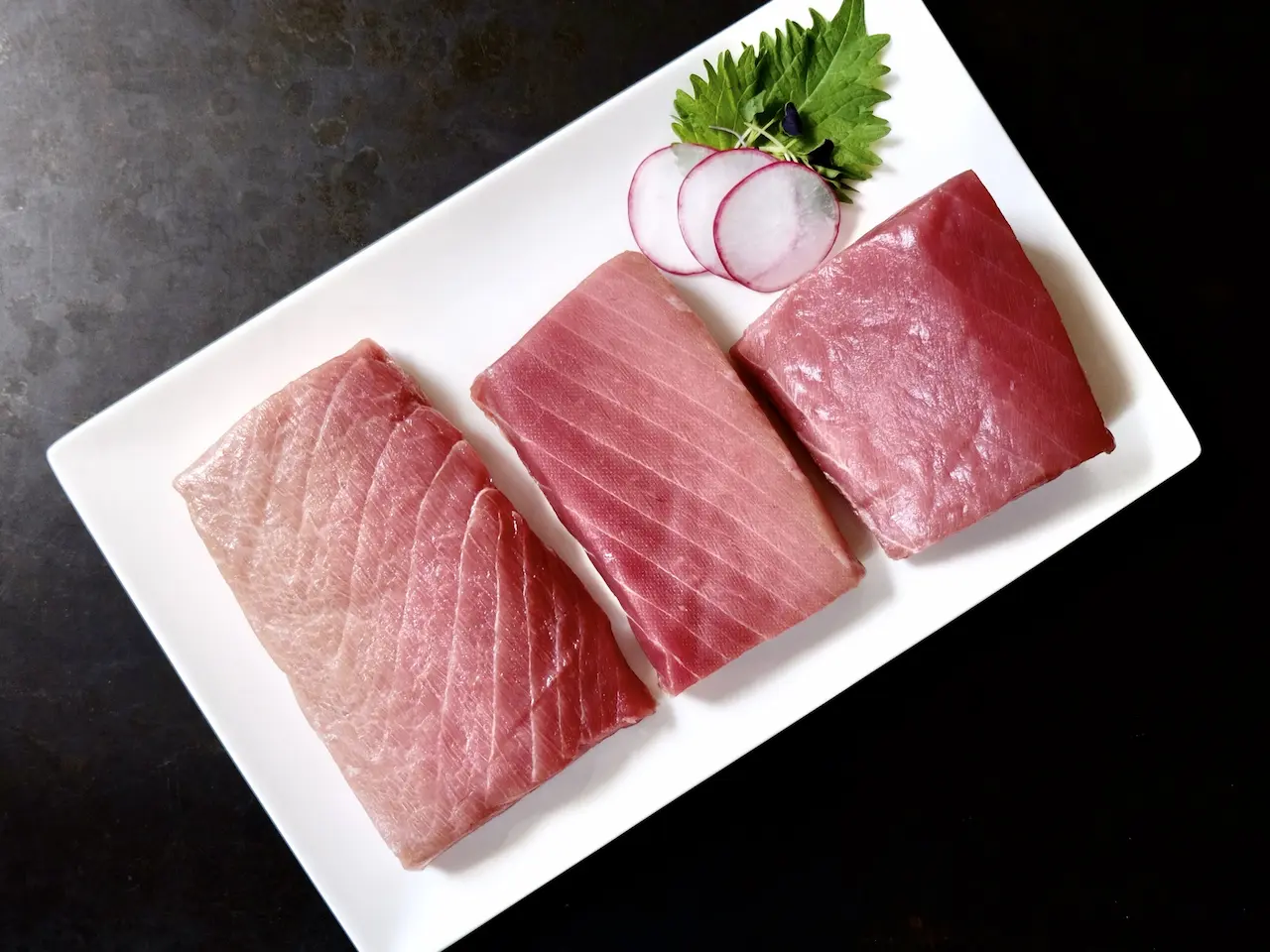
Goto Islands, Nagasaki · Hosei Suisan · Ikejime
Bluefin Tuna
Otoro, Chutoro, Akami — ikejime-processed and never frozen.
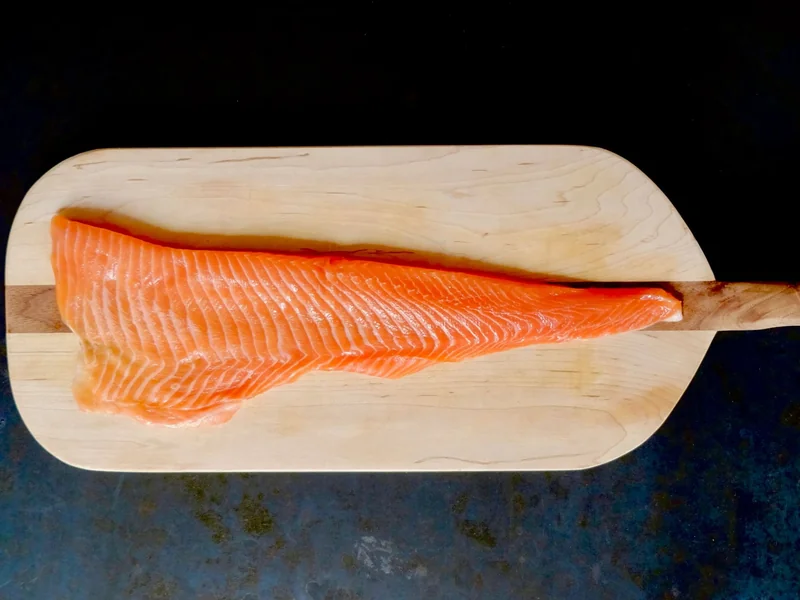
Kagoshima · Satsuma Sendai Unagi · Ikejime
Sasshu Salmon
Tank-raised on Chiran tea water, ikejime-processed, never frozen.
Ike Jime Federation
The Ike Jime Federation is a US-based organization of commercial and recreational anglers engaged in what they call "a considered kill" — ikejime-guided fish handling, disciplined by science. Based in the DMV region, the Federation is the leading North American institution promoting the adoption of ikejime principles among American fishermen, chefs, and seafood buyers.
Their mission addresses a real structural problem: the US has some of the world's finest wild fish — Bluefin Tuna off New England, snapper in the Gulf, salmon in Alaska — but dockside handling practices have historically lagged far behind Japan. Lower dockside prices incentivize volume over care, and the equipment and knowledge needed for a considered kill have been largely unavailable to American fishermen. The Federation provides education, tools (brain spikes, wires for shinkei-jime), and certifications. Their resources page is the most thorough English-language primer on ikejime technique available.
Sashimi DC and the Ike Jime Federation share the same conviction: the quality of fish at the table is decided at the moment of death. Everything else — cold chains, vacuum packaging, air freight — is preserving quality, not creating it.
Sources
- Anders, N., Eide, I., Lerfall, J., Roth, B., & Breen, M. (2020). Physiological and flesh quality consequences of pre-mortem crowding stress in Atlantic mackerel (Scomber scombrus). PLOS ONE. https://doi.org/10.1371/journal.pone.0228454 — All fish were killed identically (percussive blow) to isolate pre-mortem crowding stress (34–60 minutes) as the sole variable.
- Ando, M., Banno, A., Haitani, M., Hirai, H., Nakagawa, T. & Makinodan, Y. (1996). Influence on Post-mortem Rigor of Fish Body and Muscular ATP Consumption by the Destruction of Spinal Cord in Several Fishes. Fisheries Science, 62(5). https://www.jstage.jst.go.jp/article/fishsci1994/62/5/62_5_796/_article/-char/ja/ — Spinal cord destruction delayed full rigor by 6–12 hours in yellowtail and red sea bream (active, pelagic species) versus untreated controls — but in plaice, a sedentary flatfish, the same procedure reached full rigor faster than the control.
- Cabrera-Álvarez, M.J. et al. (2025). Stunning and slaughter methods in gilthead seabream: Animal welfare and muscle quality. Aquaculture. https://doi.org/10.1016/j.aquaculture.2025.742963 — Compares asphyxiation, electrical stunning, and ikejime in gilthead seabream.
- Daskalova, A. (2019). Farmed fish welfare: stress, post-mortem muscle metabolism, and stress-related meat quality changes. International Aquatic Research, 11, 113–124. https://link.springer.com/article/10.1007/s40071-019-0230-0 — Reviews the biochemical pathway: pre-harvest stress → cortisol release → glycogen depletion → accelerated lactic acid production → lower ultimate pH → softer texture, shorter shelf life.
- Erikson, U. & Misimi, E. (2008). Atlantic Salmon Skin and Fillet Color Changes Effected by Perimortem Handling Stress, Rigor Mortis, and Ice Storage. Journal of Food Science, 73(2). https://doi.org/10.1111/j.1750-3841.2007.00617.x — Calmly handled (anesthetized) versus exhausted Atlantic salmon showed measurably different skin and fillet color immediately after death and through the early rigor period — differences that narrowed by day 7 of ice storage.
- Gräns, A., Kenter, L., Meinhold, W., Saxer, A., Schwerte, T., & Brijs, J. (2026). From tradition to innovation: Effects of manual and automated ikejime on welfare and product quality of rainbow trout and hybrid striped bass. Aquaculture, 613(Part 2), 743458. https://www.sciencedirect.com/science/article/pii/S0044848625013444 — EEG-based neurological validation study, not a biochemistry trial.
- Howgate, P. (2005). Kinetics of degradation of adenosine triphosphate in chill-stored rainbow trout (Oncorhynchus mykiss). International Journal of Food Science and Technology, 40(6), 579–588. https://doi.org/10.1111/j.1365-2621.2005.00924.x — Quantifies ATP → ADP → AMP → IMP → inosine → hypoxanthine degradation in fresh fish.
- Huss, H. H. (1995). Quality and Quality Changes in Fresh Fish — 5. Postmortem Changes in Fish. https://www.fao.org/4/v7180e/v7180e06.htm — FAO reference on rigor mortis onset, progression, and resolution in fish muscle; the relationship between pre-slaughter stress and rigor speed; and the biochemical basis of freshness indicators (K-value, TVB-N).
- Ike Jime Federation. (n.d.). What is Ike Jime? https://ikejimefederation.com/what-is-ike-jime/ — US-based (DMV-region) organization of commercial and recreational anglers promoting considered-kill ikejime protocols in North America — cited in the guide as the leading English-language resource on ikejime technique.
- Mercogliano, R., Avolio, A., Castiello, F., & Ferrante, M. C. (2024). Development of Welfare Protocols at Slaughter in Farmed Fish. Animals, 14(18), 2730. https://doi.org/10.3390/ani14182730 — Reviews the regulatory landscape of fish welfare at slaughter across EU, Norway, and Japan.
- Naka, S. (2016). Assessment of physio-chemical parameters in farmed mulloway (Argyrosomus japonicus) to establish optimal post-harvest practice. Southern Cross University (Master's thesis). https://researchportal.scu.edu.au/esploro/outputs/graduate/Assessment-of-physio-chemical-parameters-in-farmed/991012820961802368 — Refines the ATP-extraction methodology used to calculate K-value and finds mulloway follow a distinct nucleotide breakdown pathway that skips certain intermediate steps — evidence that K-value thresholds require species-specific calibration rather than a single universal formula.
- Tsukamasa, Y., Fukuda, T. & Ando, M. (2022). Effects of Sodium Chloride Treatment and Short-Term Aging on the Amount of Taste-Related Compounds in Meat of Red Sea Bream. Nippon Suisan Gakkaishi. https://doi.org/10.2331/suisan.21-00040 — Studies the effect of salt (NaCl) treatment and dehydration sheets during short-term aging of already-ikejime-killed red sea bream — not a study of ikejime itself.
- Wang, Z. et al. (2024). Postharvest quality evaluation of masu salmon (Oncorhynchus masou) during ice storage by spinal cord and bleeding. Journal of Food Composition and Analysis. https://doi.org/10.1016/j.jfca.2024.106606 — Direct salmonid ikejime study.
- Zampacavallo, G., Parisi, G., Mecatti, M., Lupi, P., Giorgi, G., & Poli, B. M. (2015). Evaluation of different methods of stunning/killing sea bass (Dicentrarchus labrax) by tissue stress/quality indicators. Journal of Food Science and Technology, 52(5), 2585–2597. https://doi.org/10.1007/s13197-014-1324-8 — Does not test ikejime. Compares ice-water slurry, gas stunning (N₂/CO₂ mixtures), and single-/two-stage electrical stunning in sea bass.
- Zhang, Z., Sun, Y., Sang, S., Jia, L., & Ou, C. (2022). Emerging Approach for Fish Freshness Evaluation: Principle, Application and Challenges. Foods, 11(13), 1897. https://www.mdpi.com/2304-8158/11/13/1897 — Covers non-destructive freshness technologies (optical spectroscopy, electronic nose, pH-indicator packaging) being deployed in premium seafood logistics.