How does Sashimi DC source its fish directly from Japan?
Sashimi DC imports bluefin tuna and Sasshu Salmon directly from processor to shop — roughly half the intermediary layers of a conventional US seafood import. Fish leaves Miyazaki, reaches IAD (Dulles) in approximately 48 hours, and is picked up personally by Keita Miyaki. No distributor, no broker, no warehouse. Fewer layers means faster transit, lower per-layer margin, and direct quality control with the source processor.
301
Google reviews · 5.0 average
2
supply chain layers (vs. 5–6 industry standard)
~48 hrs
from Miyazaki processing to DC
951
completed deliveries
As of September 2026.
Why direct import matters
The United States imports approximately 75–90% of the seafood it consumes. The conventional import chain runs through at least five or six layers: farmer or fishery, processor, exporter, importer, distributor, and finally retailer. Each layer adds transit time, temperature transitions, and margin — and none of them owns quality as a primary concern. This stands in contrast to cultures where raw fish traditions developed around proximity and freshness — Japan being the defining example.
Sashimi DC's chain is roughly half that length: the farmer and processor in Japan deal directly with the retailer in Washington DC, with no exporter, importer, or distributor between them. The fish moves faster, fewer hands touch it, and there is a direct line to fix problems at source. Fewer intermediary layers also tends to mean more of the final price reaches the producers at the start of the chain, with freshness and traceability as the primary value drivers (Advani et al., 2024).
That matters more than it sounds. The US seafood market has a significant integrity problem at the industry level — one that a shorter supply chain and independent certification address directly.
Authenticity & sourcing credentials
Against the backdrop of industry-wide mislabeling and traceability gaps, one thing distinguishes Sashimi DC's sourcing: it is formally authenticated by the Japanese government. Sashimi DC holds certification as a Japanese Food and Ingredient Supporter Store (ID: J000-001-410, valid May 2026 – May 2028) under guidelines issued by Japan's Ministry of Agriculture, Forestry and Fisheries (MAFF) and administered by JETRO (Sashimi DC listing). The program certifies overseas retailers that consistently sell authenticated Japanese-origin seafood and accurately represent their provenance.
Sashimi DC is one of three certified establishments in Washington DC — the others are Sushi Taro, one of the city's most established Japanese restaurants, and, as of August 2026, DC Sake Co — and the only certified fish retail counter in the city.
Every shipment comes directly from Japan — Goto Islands bluefin, Kagoshima salmon and unagi, Hokkaido uni — processed at source using the same ikejime method, never frozen, arriving at Dulles within approximately 48 hours of leaving Miyazaki. All Bluefin Tuna imports comply with NOAA's Seafood Import Monitoring Program (SIMP), a federal regulation requiring full catch documentation at every step: vessel name, fishing area, gear type, and catch date. SIMP is a compliance requirement, not a voluntary certification.
Quality control through direct relationships
The value of a short supply chain is not just speed. It is the ability to communicate directly with the processor when something is off — and to get it fixed. In a conventional import chain with five or six intermediary layers, a quality observation made at the retail counter in Washington DC would need to travel back through a distributor, an importer, and an exporter before reaching the source. By that point the batch is sold, the fish is gone, and nothing changes.
With a direct relationship, the conversation is one step. The following are real examples of problems caught and corrected through that channel.
Chutoro · Color
The Hiyashikomi incident
One batch of Chutoro arrived with the white marbling intact but the surrounding pink flesh looking duller than usual — not off in flavor or texture, but visually below standard. Keita flagged it to the processor directly.
The cause was identified within hours: Hiyashikomi — the post-harvest icing protocol — had not been applied as rigorously as standard that week. The processor corrected the protocol immediately. The same issue has not recurred.
Packaging · Cold Chain
The absorbent sheet incident
Moving into warmer months, the processor tested a heavier absorbent sheet inside the oxygen-reduced packaging to manage higher moisture levels during transit. It worked too well — the sheet pulled moisture out of the fish itself, affecting texture.
Keita identified the cause and communicated it back. The processor reverted to the standard sheet. The test had been a reasonable adaptation; the feedback loop made it correctable before it became a pattern.
Saku Blocks · Consistency
Saku weight variance (early days)
In the early months of the direct import relationship, the processor was cutting Saku blocks for the first time to Keita's specifications. Weight variance was significant — customers occasionally received pieces meaningfully larger or smaller than advertised.
Keita raised the issue; the processor standardized their cut weights. Variance is now consistent and within a tight range. This kind of calibration only happens when you can speak to the cutter directly.
Chutoro · Texture
Senaka cut improvement
Through direct dialogue in early 2026, the Senaka cut was adjusted so that Chutoro blocks now contain fewer sinews — producing smoother texture across the piece. This was not a problem report; it was a quality refinement identified through ongoing communication.
Small improvements like this compound over time. They happen because Keita can message the QA manager overnight and receive a response by morning — not file a ticket with a distributor.
Packaging · Logistics
Box reinforcement at IAD
One shipment arrived at IAD with a cracked Styrofoam box — almost certainly dropped during cargo handling. TTI indicators and unmelted ice packs confirmed the fish condition was unaffected, but the structural failure was documented and communicated to the processor.
They responded by adding reinforcement tape around the body of each box — not just the standard lid-sealing tape, but structural tape running around the full perimeter for robustness. Every shipment since has arrived intact.
Cold Chain · Air Freight
Cargo room temperature management
Pet animals sometimes travel on the same ANA flights as fish shipments, and are held in an air-conditioned cargo room to protect them. Keita identified that fish held in the same heated room would face unnecessary temperature risk.
Working through ANA OCS (the forwarding agent), a standing instruction was added to hold the fish shipment in a separate, unheated cargo room — maintaining cold chain integrity from Japan to the IAD cargo counter where Keita picks up every shipment personally.
What this actually means. Every one of these improvements was only possible because there is a direct line of communication to the processor. None of them required a formal complaint process, a distributor escalation, or waiting for the next shipment cycle. Quality improvement in a direct-import model is iterative and fast. That is the structural advantage — not just fewer layers, but faster learning.
That same traceability is why private and family chefs buy from us: portioned fish, a catch certificate with every bluefin shipment, and a processor Keita can reach overnight. See fish for private chefs.
The US seafood supply chain: what the data shows
Understanding why this model matters requires a clear-eyed look at what the mainstream US seafood supply chain actually produces. Three data points frame the problem.
Mislabeling is pervasive. A meta-analysis published in Food Control (Ahles et al., 2024) examined 35 US seafood studies covering 4,179 samples from 32 states, collected between 2010 and 2023. The overall mislabeling rate was 39.1% — nearly two in five seafood products carried the wrong label. Species substitution was the leading form, affecting 26.2% of samples. NOAA's own inspectors, who review roughly 20% of US seafood consumption annually, find some form of fraud in up to 40% of voluntarily submitted products.
Illegal fishing is structurally embedded in imports. An estimated 11% of all US seafood imports — valued at approximately $2.4 billion annually — derive from illegal, unreported, or unregulated (IUU) fishing, according to a US International Trade Commission report cited in a 2024 Congressional Research Service analysis (Keating-Bitonti & Marshak, 2024). IUU fishing avoids the operational costs of sustainable management, introduces mislabeled product, and is associated with labor exploitation including forced labor and debt bondage. The economic losses to legitimate producers are estimated at $26–50 billion annually.
Federal traceability requirements remain weak. NOAA's Seafood Inspection Program is voluntary; most processors do not participate. The FDA Food Traceability Rule (FSMA Section 204), which would require rigorous lot-code tracking across the supply chain with records available to FDA within 24 hours, was originally scheduled for compliance in January 2026. Congress has since directed the FDA not to enforce it before July 2028 — pushing full traceability accountability more than two years further out. In the meantime, the primary mandatory traceability mechanism for seafood is NOAA's SIMP, which applies to specific high-risk species including Bluefin Tuna.
Sashimi DC vs. conventional import
| Conventional US seafood import | Sashimi DC | |
|---|---|---|
| Supply chain layers | 5–6 (farmer → processor → exporter → importer → distributor → retailer) | 2–3 (farmer → processor → retailer) |
| Species verification | Voluntary; mislabeling rate 39.1% industry-wide | MAFF-certified (J000-001-410); JETRO-verified Japanese-origin fish |
| Traceability | Fragmented; FDA Traceability Rule enforcement deferred to 2028 | NOAA SIMP-compliant for Bluefin; direct processor documentation per shipment |
| IUU risk | ~11% of US imports from illegal fishing | Zero — direct relationship with named farm and named processor |
| Quality feedback loop | Problems at retail rarely reach source; no direct channel | Overnight message to QA manager; issues corrected within one shipment cycle |
| Cold chain | Multiple temperature transitions; condition often unknown to retailer | Seasonal ice pack adjustment; TTI per shipment; personal pickup at IAD |
| Processing | Variable; CO treatment common in tuna | Ikejime (Hosei Suisan, Goto); never CO-treated; never frozen |
The three cost factors
Every shipment of fish from Japan to Washington DC passes through the same chain: air freight from Fukuoka or Haneda to Dulles (IAD), customs clearance with applicable duties, and terminal handling at the cargo facility. Each of the three legs has gotten meaningfully more expensive over the past year, and all three are operating at the same time.
This page explains each one factually, with the actual numbers. It is not a complaint — cost volatility is part of operating a direct-import business — but transparency about what is happening seems more useful than silence.
1 · US tariffs on Japanese fish
The tariff situation on Japanese imports has changed five times since April 2025 and is still not fully resolved. The short version: there was a 15% tariff on Japanese goods from August 2025 through late February 2026, then the Supreme Court struck down the legal basis for it, a 10% Section 122 surcharge applied from February 24, 2026 through its 150-day expiration on July 24, 2026, and Japanese fish imports are now subject to a 12.5% tariff under a Section 301 forced-labor enforcement action.
Timeline
- Apr 2, 2025 President Trump signs Executive Order 14257 establishing a 10% global baseline tariff and a 24% country-specific rate for Japan under IEEPA (International Emergency Economic Powers Act).
- Apr 9, 2025 The 24% Japan rate is scheduled to take effect. That afternoon, the administration announces a 90-day suspension for Japan and other negotiating partners, dropping to the 10% baseline while bilateral talks proceed.
- Jul 7, 2025 As the pause nears expiration, the deadline is extended to August 1. The administration warns of a 25% rate if no agreement is reached.
- Jul 22, 2025 Negotiators reach a preliminary framework agreement. The US agrees to a 15% IEEPA tariff on Japan in exchange for Japan committing to $550 billion in US investments and increased agricultural and energy purchases.
- Sep 4, 2025 Executive Order 14345 implements the deal. The 15% rate applies retroactively to August 7 for most goods including fish.
- Feb 20, 2026 The Supreme Court rules 6–3 in Learning Resources, Inc. v. Trump that IEEPA does not authorize the President to impose tariffs. Chief Justice Roberts, writing for the majority, held that the statute's silence on tariffs — despite Congress consistently using explicit language when delegating tariff authority — was decisive. The IEEPA-based tariffs are vacated.
- Feb 24, 2026 All IEEPA tariffs are terminated. The same day, the administration implements a 10% surcharge under Section 122 of the Trade Act of 1974 — a different statutory authority that explicitly permits balance-of-payments tariffs, capped at 15% and limited to 150 days unless extended by Congress.
- Feb 24 – Jul 24, 2026 10% Section 122 tariff in effect on Japanese imports including fish, running the full 150-day statutory limit.
- Jul 24, 2026 (current) Section 122 expires at its 150-day limit. Japanese fish imports move to a 12.5% tariff under Section 301, tied to a forced-labor enforcement action rather than the earlier balance-of-payments authority.
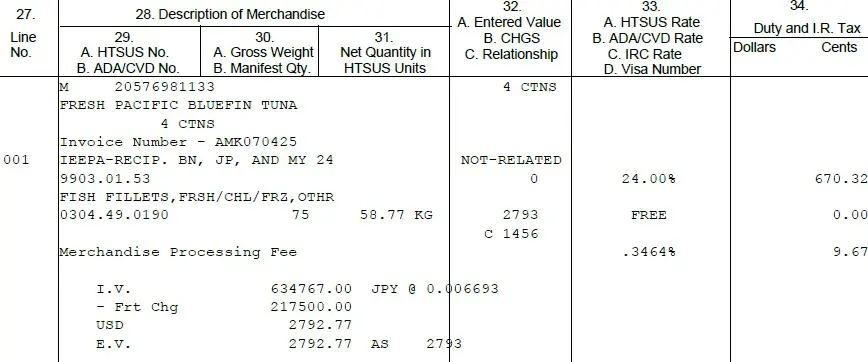
IEEPA refunds — CAPE
CBP launched CAPE (Consolidated Administration and Processing of Entries) on April 20, 2026 — a system to process refunds of duties paid under the now-invalid IEEPA tariffs. Phase 1, which went live on April 20, covers unliquidated entries and entries liquidated within the prior 80 days, estimated at roughly 63% of affected entries. Phase 2 launched June 29, 2026, covering reconciliation entries (entries still subject to the 314-day liquidation cycle). Phase 3 covers finally liquidated entries — but CBP's position is that it cannot issue refunds on finally liquidated entries absent a court order, and Phase 3 refunds are limited to importers who filed suit challenging that restriction. Sashimi DC did not file such a suit, so shipments that reached finally-liquidated status before the refund window opened will not receive a refund through CAPE. Refunds for accepted CAPE declarations are expected within 60–90 days of approval.
Import cost impact — tariffs. The current 12.5% Section 301 tariff (forced-labor category) applies to the full declared customs value of each shipment — fish plus packaging — effective since the Section 122 surcharge expired on July 24, 2026. That is 2.5 percentage points above the 10% Section 122 rate that applied February–July 2026, and 2.5 points below the 15% IEEPA rate that applied August 2025–February 2026.
2 · Air cargo fuel surcharge (ANA Cargo)
Fish travels on ANA Cargo flights from Fukuoka or Haneda to Dulles. The fuel surcharge is set by ANA Cargo and revised monthly — or since April 2026, semi-monthly — based on the Singapore Jet Kerosene (Platts) index. The surcharge applies to the entire shipment weight including packaging and ice packs.
The surcharge was relatively stable throughout 2024 and 2025, ranging between ¥64 and ¥106/kg. It held in the ¥71–85/kg band from mid-2025 through the end of Q1 2026. Then in April 2026 it moved sharply: from ¥78/kg on April 1 to ¥247/kg on April 16 — a tripling in two weeks. It has since declined and partly rebounded: ¥226/kg from May 1, ¥149/kg from June 1, ¥142/kg from June 16, ¥135/kg from July 1, ¥107/kg from July 16, ¥128/kg from August 1, ¥163/kg from August 16, ¥149/kg from September 1, ¥156/kg from September 16, and — already scheduled — ¥191/kg from October 1, 2026, a renewed climb back toward the April peak.
ANA Cargo fuel surcharge (¥/kg) · Jan 2024 – Sep 2026. Includes full shipment weight (packaging + ice packs). Apr 16, 2026: ¥247 — peak. Source: ANA Cargo fuel surcharge notices.
Import cost impact — fuel surcharge. A typical bluefin shipment weighs 100–120 kg including packaging and ice. The April 16 peak of ¥247/kg versus the Q1 baseline of ¥78/kg added approximately ¥16,900–20,300 per shipment in fuel cost. The rate eased over the summer before climbing again — reaching ¥191/kg from October 1, 2026, still below the April peak but ¥113/kg above the Q1 baseline, adding approximately ¥11,300–13,560 per shipment in fuel cost above pre-spike levels.
3 · IAD cargo terminal charges
Every air waybill (AWB) cleared through the cargo terminal at Dulles carries a handling fee. This has risen significantly since 2024 — and the structure of the charge has become more complex. In 2024, there was a single processing fee of $10 on top of the base terminal charge. The current bill includes the base terminal charge plus a processing fee, a credit card fee, and a convenience fee — different charges added over time, now totaling $37.98 in fees on top of the base rate.
IAD cargo terminal charge (USD/AWB) · Jan 2024 – Mar 2026. Includes all processing, credit card, and convenience fees.
The terminal charge has risen 55% from the 2024 baseline — from $150 to $232.98 — in roughly two and a half years. Part of this is inflation; part is the layering of new fee categories. The practical effect is the same either way: a higher fixed cost on every shipment regardless of fish weight or value.
Combined picture
These three costs operate independently and compound. A shipment arriving in late April 2026 faced all three simultaneously: the 10% Section 122 tariff on declared value, a fuel surcharge at roughly three times the Q1 level, and terminal handling costs that have more than doubled since 2024. As of late September 2026, the mix has shifted but not eased: a shipment now faces the 12.5% Section 301 tariff, a fuel surcharge of ¥156/kg (the September 16 rate) that is already scheduled to rise to ¥191/kg on October 1, 2026 — down from the April peak but climbing back above the Q1 baseline — and the same elevated terminal handling costs. None of these is within our control. What we can control is how honestly we account for them.
Import cost drivers — current (September 2026) vs. baseline
What this means for retail prices
Some of these cost increases are absorbed — margin compression is an unavoidable part of operating in a volatile import environment. Some portion is passed through to retail prices. We will not pretend otherwise. When prices change, it is because the underlying import cost has changed, not arbitrarily.
The tariff situation in particular remains fluid. The Section 122 surcharge expired at its 150-day statutory limit on July 24, 2026; Japanese fish imports are now subject to a 12.5% tariff under a Section 301 forced-labor enforcement action. IEEPA refunds through the CAPE system are in progress: CAPE Phase 2 launched June 29, 2026 (reconciliation entries); Phase 3 refunds for finally liquidated entries are limited to importers who filed suit challenging that restriction, which Sashimi DC did not do, so those entries will not receive a refund. Fuel surcharges are revised every two weeks and can move quickly in either direction. We will update this page as the situation develops.