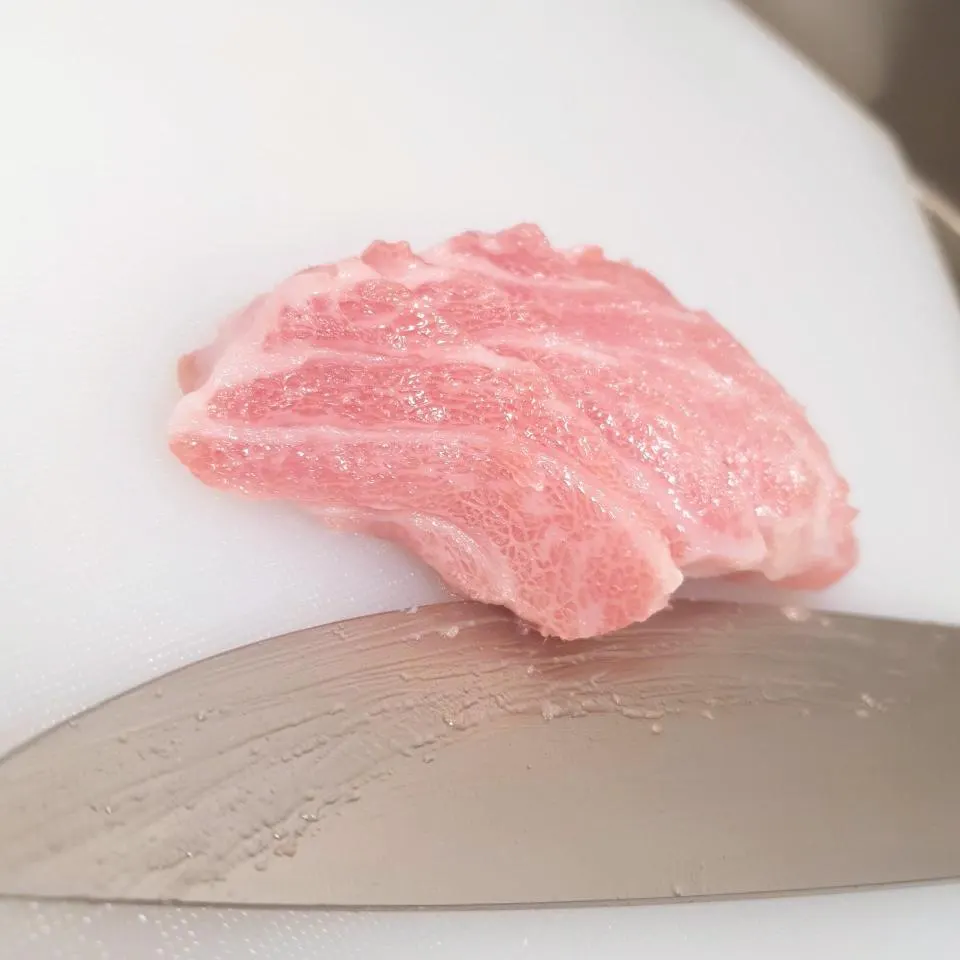
Is February a good time to buy Bluefin Tuna Otoro in Washington DC?
Yes — February is peak season for Bluefin Tuna Otoro. Cold winter water lowers the fish's metabolic rate while feeding continues, driving deep intramuscular fat accumulation. Sashimi DC's Goto Islands Bluefin, Ikejime-processed at Hosei Suisan in Nagasaki, arrives ~24–48 hours from Miyazaki. Order Thursdays–Fridays for freshest stock.
This Week's Bluefin — Second Best of the Season
We track quality carefully, week by week, and we say this with confidence: this week's Nagasaki Bluefin Tuna from Hosei Suisan is the second best fish we have received this season, behind only the exceptional January shipment we flagged a few weeks ago. The fat content is at or near its February peak; the Ikejime processing preserved the texture and umami without any degradation in transit. The Otoro is deeply marbled. The Chutoro has that specific balance — part fat, part clean lean muscle — that makes it the most nuanced cut on the fish. Don't miss this week.
Windy Weather in Japan — Limited Variety
Japan has been experiencing persistent strong winds this week, which has reduced the number of fishing boats going out and contracted the variety of fish available at the Toyosu market. We have less variety than usual as a result: the Bluefin, sourced from a farm rather than wild-caught, is unaffected by weather at sea. But the more unusual white fish and shellfish that depend on day-boat catches are not available this week.
What is available alongside the Bluefin: Hotate (Hokkaido Scallops), Mahata (七帯石鯛, Sevenband Grouper) — which has been aging well in the counter and is now at peak flavor — frozen Hotaruika, and Kinmedai. A limited quantity of Murasaki Uni in small boxes is also available this week despite elevated prices; we secured it specifically because the Bluefin quality this week makes it a natural pairing.
Boston Natto — Restocked
Boston Natto from Aya's Culture Kitchen (@ayas_culture_kitchen) sold out within two weeks of arriving at Rice Market — 24 packs gone when the typical monthly turnover of frozen natto is 7 to 8 packs. The quality speaks for itself in numbers like that. It is now restocked. If you missed the first batch, this is the opportunity. Fresh natto behaves differently from frozen: more alive, more complex, less sharp. Worth experiencing if you haven't.
On Aging Fish — the Mahata
The Mahata (Sevenband Grouper) we received last week has been resting in the counter and is now better than it was on arrival. This is worth explaining, because it runs counter to the intuition that fresher is always better.
Large, dense-fleshed white fish like grouper benefit from controlled aging in the same way that beef does. Immediately after Ikejime, the muscle is still in rigor and the texture is firm to the point of toughness — the flavor is clean but not yet developed. Over two to four days at refrigerator temperature, enzymatic activity breaks down muscle proteins, relaxing the texture and concentrating the amino acids that register as umami. The fish becomes softer, richer, and more layered. The Mahata this week has had the right amount of time. Ask for it specifically at the counter.
On aged sashimi: Not all fish age well. Lean, delicate fish like Flounder (Hirame) and Sea Bream (Madai) are exceptions that can age several days with proper handling. Fatty fish like Bluefin are best fresh — the fat oxidizes over time. Firm white fish like grouper and Kinmedai are the best candidates for aging. When in doubt, ask at the counter how long a specific fish has been in.