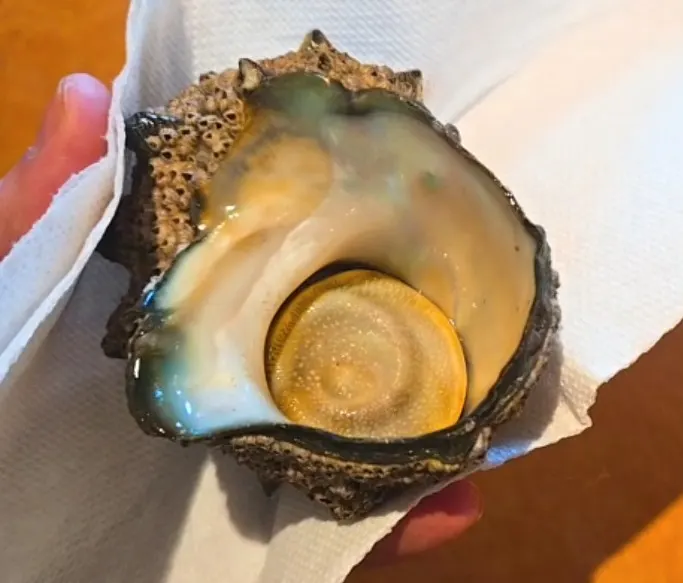
What is Sazae (Turban Shell) and how do you prepare it at home?
Sazae (サザエ, Turban Shell) is a large Japanese marine snail with firm, chewy flesh and a briny, mineral flavor unlike scallop or clam. It's one of the most distinctly Japanese shellfish experiences. To extract the meat, use a thin pick or knife — the muscle is firmly attached inside the spiral shell. Available seasonally at Sashimi DC, 1608 14th St NW, Washington DC.
Sazae — A Childhood Memory from Izu Oshima
We are trying something new this week: Sazae (サザエ, Turban Shell). This is a large, conical marine snail — technically a gastropod — with a tightly spiraled shell and a firm, slightly chewy muscle inside. It is one of the more distinctly Japanese shellfish experiences: the flavor is briny and clean, with a mineral quality that reads differently from scallop or clam, and the texture is unlike anything else in our lineup.
A word of practical advice: be careful when extracting the meat from the shell. The Sazae is alive when it arrives and the muscle is firmly attached. A small pick or the tip of a thin knife is needed to work it free. The first time takes patience; once you've done it, the method is clear.
I have a personal connection to this shellfish that I've been wanting to write about since we first received it.
Izu Oshima — The Restaurant Called Koma
When I was a child, my father took me to Izu Oshima, the volcanic island roughly 100 kilometers south of Tokyo in Sagami Bay. We had lunch at a local restaurant whose garden was entirely covered with Sazae lids — hundreds of them, sun-bleached and stacked in the way that accumulates over years of feeding a fishing community. It was the first time I had encountered the shellfish, and the first time I tried Sazae sashimi.
The texture surprised me: crunchy in a way that fish isn't, with a snap to the muscle that I hadn't expected. The flavor was clean and deeply oceanic. I liked it immediately — not because I was told to, but because it was genuinely interesting. It tasted like the sea in a specific way, different from Uni or scallop or anything else on the table.
I still remember the name of the restaurant: Koma (こま). I don't know whether it still operates. But the memory of that garden of Sazae lids, and the particular flavor of the shellfish served fresh at that lunch, is the reason this ingredient is on our counter this week. Some things you source because the market demands them. Some you source because you've been meaning to bring them here for a while.
This Week's Fish
A strong week alongside the Sazae experiment:
- Nagasaki Bluefin Tuna — all cuts, peak winter quality continuing from last week. Order here →
- Bafun Uni from Rausu, Hokkaido — one of the coldest and most prized Uni origins on the Hokkaido Pacific coast
- Murasaki Uni from Nezaki, Hokkaido — at competitive prices this week
- Suzuki (鱸, Japanese Sea Bass) — thought of as a summer fish, but winter Suzuki is notably fatty and well-suited to this time of year. The fat distribution is different from summer — fuller and richer throughout the fillet.
- Madai Kobujime (真鯛昆布締め) — a small amount of sea bream that has been kelp-cured. The Kobujime process draws moisture from the fish and transfers the umami of the kombu into the flesh, producing a firmer texture and a deeper, more layered flavor than fresh Madai sashimi. Available in limited quantity.
- Hotate Scallops and Kinmedai also available
Closed Thursday — Japanese Embassy Event
We will be closed on Thursday, January 30th to participate in an event hosted by the Japanese Embassy. I will be processing a whole Yellowtail (Buri) into sashimi in front of the guests — breaking down a full fish live, explaining the cuts, and demonstrating the Ikejime technique. Wish me luck.
On Sazae: If the live shellfish preparation feels intimidating, bring it to the counter and we will show you the technique in person. It takes two minutes once you've seen it done. The reward is a piece of shellfish that is genuinely unlike anything else we carry — and a connection to a specific way of eating that has been part of Japanese coastal culture for centuries.