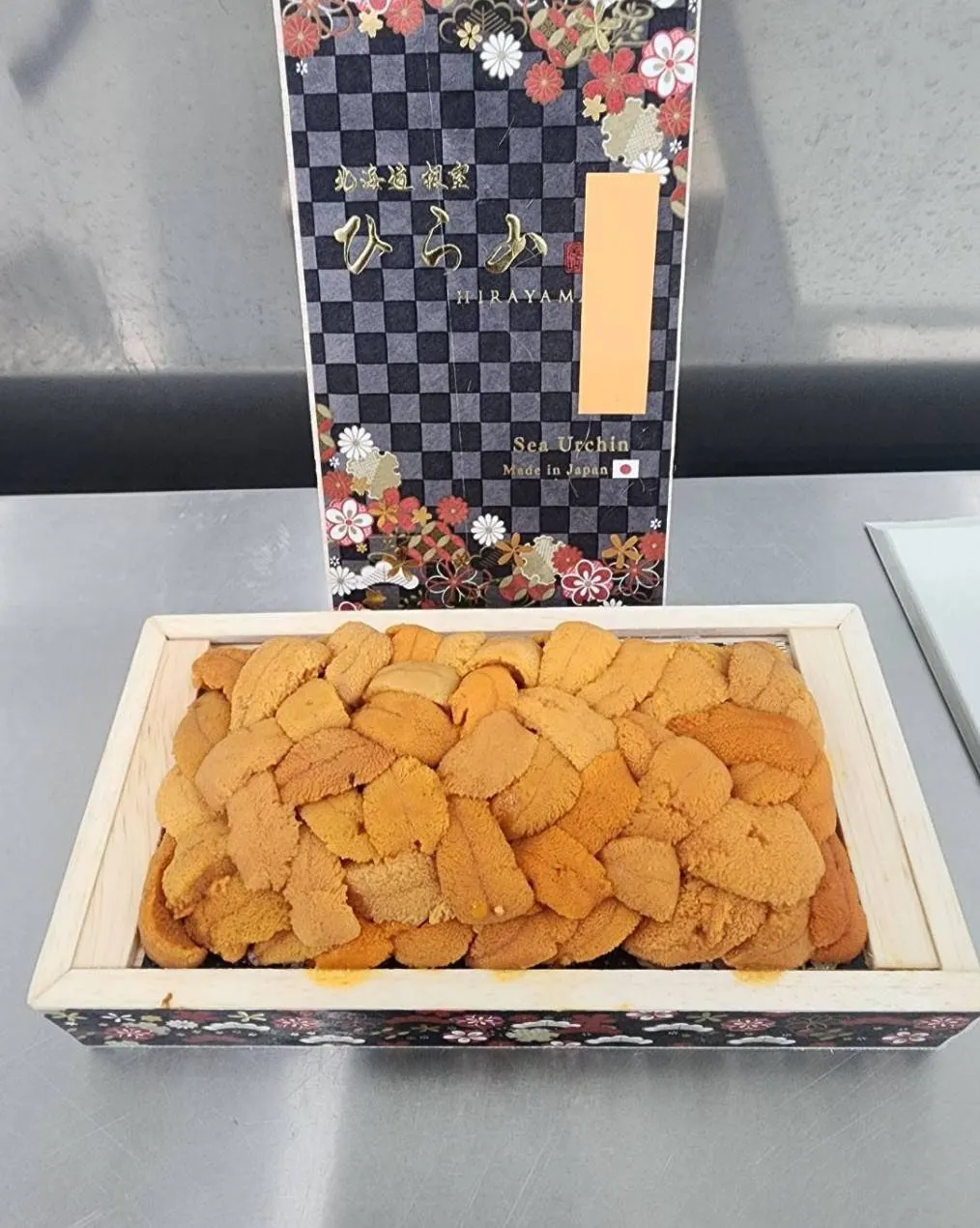
What makes Rebun Island Uni special compared to other Hokkaido sea urchin?
Rebun Island (礼文島) lies at the northernmost tip of Hokkaido where two ocean currents meet, keeping water cold year-round. This drives exceptional kelp growth — the same kombu the sea urchins feed on — producing Bafun Uni with a pronounced sweetness alongside deep brininess. One of Japan's most prized Uni origins.
This Week's Uni — Bafun from Rebun Island, Hokkaido
This week we have Bafun Uni (馬糞ウニ) from Rebun Island (礼文島), Hokkaido — arriving in small boxes of 80–90g. Rebun Island lies just north of Rishiri Island at the very tip of Hokkaido, in the cold Tsugaru Strait where two ocean currents meet. The water temperature stays low year-round, which drives exceptional seaweed growth — the same high-quality kombu and wakame that the sea urchins feed on, and that makes this origin consistently one of the most sought-after in Japan.
Rebun and Rishiri Uni are close in character — both carry the depth that cold-water kelp-feeding produces — but Rebun tends toward a slightly more pronounced sweetness alongside the brine. Reserve online to secure your box.
Summer Heat in Kyushu — What It Means for Bluefin
Japan's Kyushu region is experiencing abnormal summer heat this year — temperatures exceeding 39°C (102°F) in some areas for the first time in 120 years. Seawater temperatures in the Goto Islands area have risen accordingly, and this is having a direct effect on the Nagasaki Bluefin Tuna.
When water is unusually warm, Bluefin Tuna eat normally but metabolize more energy for basic body function — less is stored as intramuscular fat. This week's fish carries noticeably less fat than the spring and early summer fish, with a higher proportion of Akami. We are temporarily sourcing from a different Goto Islands farm in August to navigate the red tide conditions affecting our primary supplier in the area; the farming grounds are nearby and the quality difference is minimal. Our regular supplier from Hosei Suisan returns for the September fish.
We do not carry Yellowtail (Hamachi) this week — the red tide that has been affecting parts of Kyushu has suspended those catches. Yellowtail will return once conditions improve, likely September.
What Red Tide Is — and Why It Affects Supply
Red tide (赤潮, akashio) is a rapid proliferation of algae — typically harmful algal bloom species — triggered by warm water temperatures and nutrient conditions. In fish farming, red tide consumes dissolved oxygen in the water and can stress or kill fish in net pens if the bloom reaches the farm. It is a genuine natural hazard, not a euphemism for something else. When we say red tide is affecting a supplier, it means their harvest is disrupted at source, not that the fish we do have is compromised.
The Bluefin Tuna we are carrying this week is unaffected — farmed in a section of the Goto area outside the red tide zone, processed and shipped normally through Fukuoka and Haneda to Washington DC.
This week's recommendation: With a leaner fish, the Akami is the cut to focus on. Consider a Zuke preparation — soy, sake, and mirin marinade overnight — which amplifies the clean umami of lean Bluefin and is best suited to this style of summer fish. See the recipes guide for the method.