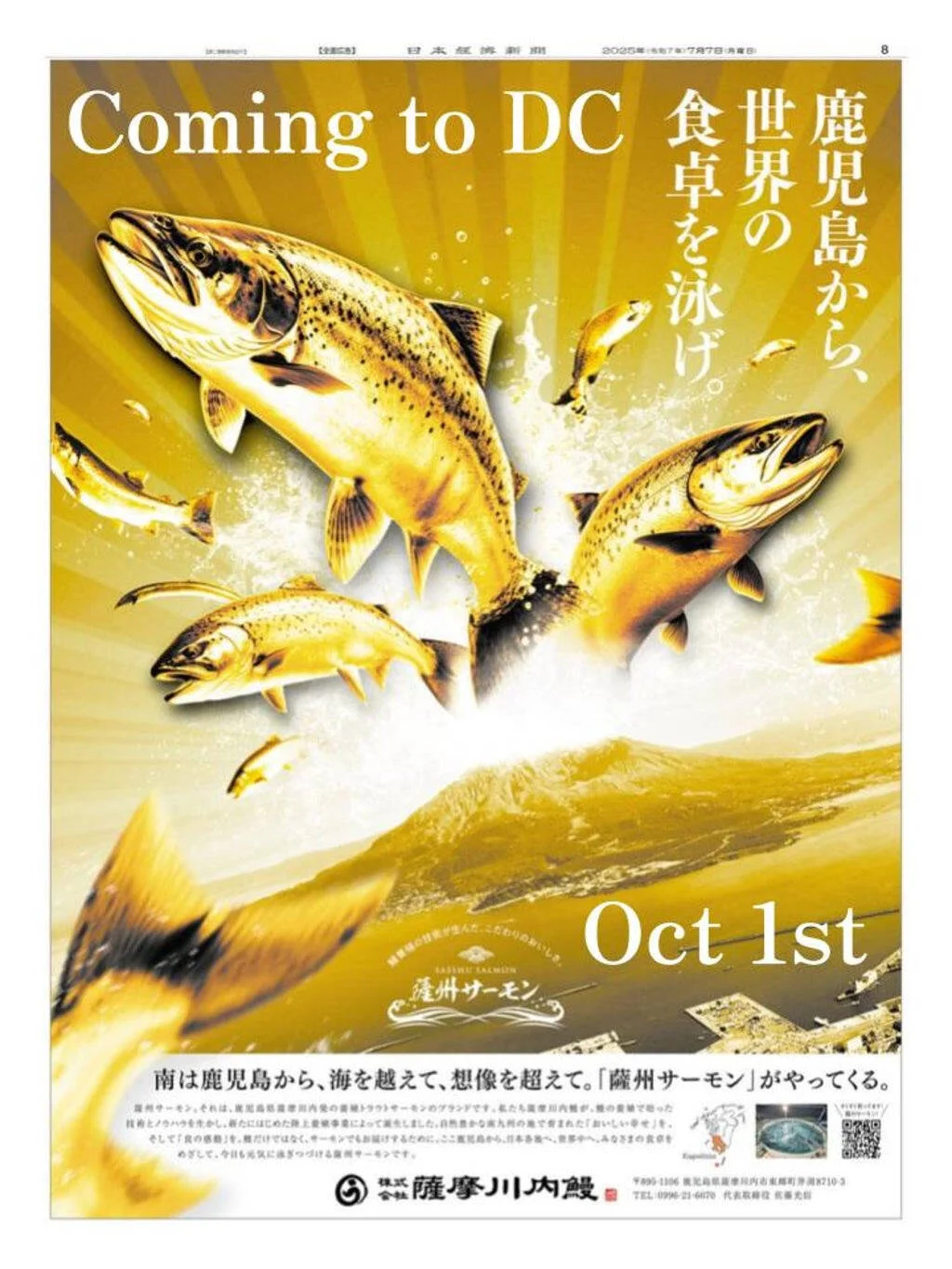
What is Sasshu Salmon and where is it available outside Japan?
Sasshu Salmon (薩州サーモン) from Kagoshima Prefecture is tank-raised on Chiran tea and Kagoshima mineral groundwater, Ikejime-processed, and never frozen. Sashimi DC holds the exclusive distribution rights outside Japan — it is the only place in the DMV to buy it. Available at Rice Market, 1608 14th St NW, Washington DC, and via same-day delivery.
In the Seafood Case This Week
Murasaki Uni: Compared to the bold orange Bafun Uni, Murasaki Uni (named for the purple color of the urchin's shell) has a lighter, more delicate yellow hue. Its flavor is remarkably elegant — sweet, clean, and carrying a refined oceanic minerality that melts effortlessly on the palate.
Tokishirazu Salmon: The highly prized "Time-ignorant Salmon" is back in stock. This wild-caught young salmon is harvested out of season before it expends energy on spawning, resulting in an exceptionally high fat content and luxurious, buttery texture.
Madai (Japanese Red Seabream): A staple of high-end sushi counters. Known for its slightly chewy texture and incredibly clean, sweet, subtle umami flavor. Fantastic simply sliced for sashimi or served kobujime style (cured between layers of kelp).
Kinmedai (Splendid Alfonsino): Deep-water favorite with rich fat and delicate sweetness.
Hokkaido Scallops: Plump, sweet, and ready for your plate.
Coming Next Week: Sasshu Salmon — An Exclusive Arrival
We are finalizing the logistics to import Sasshu Salmon (薩州サーモン) directly from Kagoshima, Japan. We will be the only purveyor outside of Japan to offer it. Keep an eye on your inbox for the official launch announcement.
In the meantime — here is what it actually is, and why it is worth your attention.
What is Sasshu Salmon?
The name comes from Sasshu — the old poetic name for Satsuma Province, the historical region that is now Kagoshima Prefecture on Japan's southernmost main island. It is produced by Satsuma Sendai Unagi, a company whose name tells the story: eel farmers who applied decades of precision aquaculture expertise to salmon, and produced something that conventional salmon farming has not.
The result is widely regarded as one of the most refined farmed salmons in the world — not because of fat content alone, but because of the precision of its flavor profile. Where commodity farmed salmon tends toward a heavy, almost one-note richness, Sasshu Salmon has a cleaner, more layered character: bright, focused umami with no off-notes, and fat that is clearly present in the marbling but does not overwhelm.
Three things that make it different
Flow-through groundwater (かけ流し養殖). The farm uses a continuous flow-through system fed by mineral-rich Kagoshima groundwater. Unlike recirculating systems where water is filtered and reused, the water here flows constantly through the tanks — always fresh, oxygen-rich, and at the precise temperature of the natural groundwater. Lower stress, protected flavor.
Chiran tea in the feed (知覧茶). The feed incorporates Chiran tea — a high-grade green tea from Chiran, Kagoshima, which holds the distinction of Japan's highest green tea production volume. The polyphenols suppress the development of off-flavors in the fat, producing what the farmer describes as "clear umami without any off-notes" (雑味のないクリアな旨み). This is not a marketing story — it is a direct explanation for why Sasshu Salmon tastes the way it does.
24/7 precision monitoring. Water temperature, oxygen levels, and tank conditions are monitored continuously — 24 hours a day, 365 days a year. The same thoroughness that eel farming demands, applied here. The result is a consistent product that tastes the same week to week, because the growing environment never drifts.
Why it can be served fresh — never frozen
Most salmon served raw in the United States must be frozen before service to eliminate parasites — a legal requirement under FDA HACCP guidelines for wild-caught fish. Sasshu Salmon is different. Because it is raised exclusively on a controlled formulated diet in a managed aquaculture environment, it has no access to infected wild prey. Under FDA regulations, fish raised on formulated feed without exposure to infected wild organisms do not carry a parasite hazard and can be served fresh, without freezing.
No freezing means no ice-crystal damage to the cell walls. The texture of properly fresh Sasshu Salmon is noticeably firmer and cleaner than frozen-then-thawed alternatives — including products marketed as "fresh" that were frozen at some point in the supply chain. The fish arrives in Washington DC at peak quality: the fat intact, the color natural, the texture exactly as it was when it left Kagoshima.
How to eat it
Excellent as straightforward sashimi — sliced at a moderate angle (sogi-zukuri, around 30–40° from vertical) to produce a larger surface area that shows the marbling clearly. The natural flavor needs no accompaniment beyond a small amount of tamari and real wasabi. It also makes outstanding Temaki, and is one of the most approachable fish for first-time home sushi — the flavor is generous and clearly delicious without requiring the nuanced palate that Bluefin Tuna rewards.
For a first order, Sasshu Salmon paired with Akami (lean Bluefin) gives a useful comparison between the two flavor profiles — the clean brightness of the salmon against the deep, direct umami of the tuna.
US exclusive: Sashimi DC will be the only place outside Japan where Sasshu Salmon is available. If you see it on a menu or at a counter in Washington DC, it came from here.