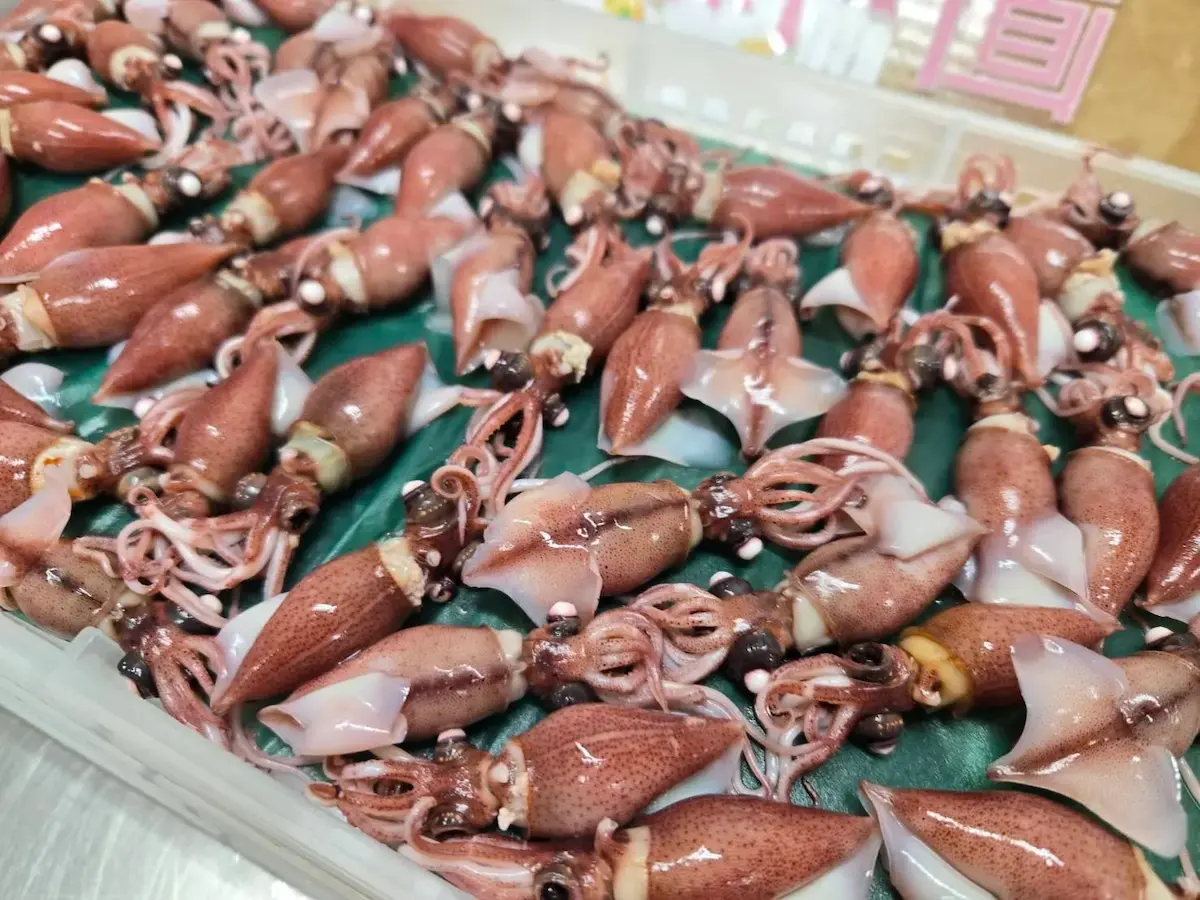
Where can I buy hotaruika (firefly squid) in Washington DC?
Sashimi DC at Rice Market (1608 14th St NW) carries hotaruika from Toyama Bay during the March–April season only. Sourced from mature females caught by fixed net at peak ripeness — lightly boiled at source to destroy parasites. Once the season ends, they're gone until next year. Available for pickup daily 11:30 am – 8 pm or same-day delivery.
A squid that glows
Hotaruika (蛍烏賊) — firefly squid — are small squid found in the deep waters of the Sea of Japan, famous for one extraordinary trait: bioluminescence. Hundreds of photophores (light-producing organs) cover their bodies, producing a vivid blue glow. During spawning season from March through April, enormous numbers of hotaruika migrate from the deep ocean toward the shallow coastal waters of Toyama Bay. The convergence is one of nature's more spectacular phenomena — the shoreline lights up blue at night, and visitors travel specifically to watch and, in some places, wade in to catch them by hand.
As a food, hotaruika are equally distinctive. The season is short — once April ends, the squid pass their peak ripeness, becoming increasingly over-matured by May and June and losing much of the flavor that makes them worth importing. What we carry is the seasonal peak: March and April.
Toyama vs. Hyogo — two origins, one season
Hotaruika come from two main sources in Japan, and the difference is worth understanding.
| Toyama 富山 | Hyogo 兵庫 | |
|---|---|---|
| Catching method | Fixed nets (定置網) | Bottom trawling |
| Sex ratio | Mostly mature females | Roughly equal |
| Size | Larger | Slightly smaller |
| Naiko (内子) | Full roe — rich, creamy burst | Less prominent |
| Price | Premium | More accessible |
Toyama hotaruika approach the shallow water of the bay specifically to spawn — fixed nets capture them at the moment they are at peak ripeness, their bodies full of roe (naiko, 内子). The naiko is the primary eating pleasure: a concentrated, creamy burst that contrasts with the firmer texture of the mantle. Hyogo squid, caught further offshore by bottom trawl with a more mixed sex composition, are also excellent — and represent better value when Toyama supply is limited.
Boiled at the port — why it matters
In Toyama, it is traditional to boil hotaruika at the beach or port immediately after landing. This is not a compromise — it is the standard preparation, and when done correctly it is superior to raw consumption in almost every way. Lightly boiled hotaruika hold their shape, concentrate their flavor, and remain tender without becoming rubbery. The key is precise timing: brief contact with boiling water, then immediate chilling.
There is also a food safety reason: hotaruika can carry larvae of the nematode genus Crassicauda in the viscera (a different parasite from the Anisakis found in most raw fish — its adult form parasitizes beaked whales). Recent Japanese surveillance puts infection at 0.6–1.6% (IASR Vol. 46, JIHS, January 2025). Boiling destroys the larvae. Raw consumption is possible if the visceral-free mantle only is used, or if the whole squid has been properly deep-frozen. Boiled hotaruika, shipped frozen, is what we carry — it is both the safest and, for most applications, the best-tasting form. Parasite Safety Guide →
How to prepare and eat hotaruika
Before eating, remove the transparent quill (pen) from inside the mantle, the hard beak from the center of the tentacles, and the two small round eyes. This takes about ten seconds per squid once you have done it a few times. Skipping this step leaves the beak and eyes in the dish — they are hard and unpleasant. The rest of the squid, including the viscera, is edible.
The classic Japanese preparation: dressed with sumiso (酢味噌) — a mixture of rice vinegar and miso. The acidity of the vinegar cuts through the richness of the viscera; the miso adds depth. Simple, traditional, and difficult to improve on.
Other applications
Hotaruika are more versatile than their delicate reputation suggests. A few worth trying:
Tempura — whole hotaruika, lightly battered. The batter protects the texture; the heat deepens the flavor. One of the better applications for people who find the raw viscera flavor too strong.
Takikomi gohan — rice cooked with hotaruika, dashi, soy, and mirin. The squid's umami permeates the rice; the result is a one-pot dish that tastes far more complex than its components.
Pasta — tossed with olive oil, garlic, chili, and a splash of white wine. Works in the same way as any squid ink pasta concept, but without the theatrics. The viscera acts as a natural sauce base.
Sashimi (chilled mantle only) — if you want a clean, delicate texture without the intensity of the viscera, slice the mantle thinly and serve cold. Ponzu works better than soy sauce here.
These are starting points. Hotaruika reward experimentation — the combination of delicate squid texture and concentrated viscera umami is an unusual ingredient profile that responds well to creative use.
Sake pairing
Sumiso-dressed hotaruika has a thick, concentrated flavor, and the vinegar-miso dressing strengthens it further. A bolder-style Junmai with high umami stands up to it best. See our sake and fish pairing guide for more.